Phase 1: Baseline

Logistic Regression, Random Forest, and XGBoost on 2019 U.S. Domestic Flights

Published

May 6, 2026

Overview

This phase establishes a reproducible baseline for 2019 U.S. domestic flight delay prediction using three model families across two tasks:

  1. Classification — predict whether a flight arrives 15+ minutes late (arrdel15).
  2. Regression — predict arrival delay in minutes (arrdelay).

Models compared: Logistic Regression, Random Forest, and XGBoost. Validation follows an expanding-window monthly CV scheme with December held out as the final test set.

Setup

import os
import time
import pickle
import warnings
from datetime import date
from pathlib import Path

import numpy as np
import pandas as pd
import pyarrow as pa
import pyarrow.dataset as ds
import pyarrow.parquet as pq
import pyarrow.compute as pc
import matplotlib.pyplot as plt

from sklearn.linear_model import LogisticRegression, LinearRegression
from sklearn.ensemble import RandomForestClassifier, RandomForestRegressor
from sklearn.metrics import (
    roc_auc_score, accuracy_score, confusion_matrix,
    mean_absolute_error, root_mean_squared_error, roc_curve
)
import xgboost as xgb

warnings.filterwarnings("ignore")
np.random.seed(42)

N_JOBS = -1
RANDOM_STATE = 42

COLORS = {
    "Logistic Regression": "steelblue",
    "Linear Regression":   "steelblue",
    "Random Forest":       "forestgreen",
    "XGBoost":             "firebrick",
}

plt.rcParams.update({
    "figure.facecolor":  "white",
    "axes.facecolor":    "white",
    "axes.grid":         True,
    "grid.alpha":        0.3,
    "font.size":         12,
    "axes.titlesize":    14,
    "axes.titleweight":  "bold",
})

def calc_mae(actual, predicted):
    return mean_absolute_error(actual, predicted)

def calc_rmse(actual, predicted):
    return root_mean_squared_error(actual, predicted)

def safe_display(df, caption=None):
    styler = df.style.hide(axis="index")
    if caption:
        styler = styler.set_caption(caption)
    display(styler)

def resolve_feature_names(model, fallback_cols):
    """Return feature names from a fitted sklearn model, falling back gracefully."""
    if hasattr(model, "feature_names_in_"):
        return list(model.feature_names_in_)
    n = len(model.feature_importances_)
    if len(fallback_cols) == n:
        return list(fallback_cols)
    return [f"feature_{i}" for i in range(n)]

print("All libraries loaded.")
All libraries loaded.

Data Loading

Place the canonical parquet file at data/flights_canonical_2019.parquet or set the FLIGHTS_2019_PARQUET environment variable.

DATA_PATH = Path(os.environ.get("FLIGHTS_2019_PARQUET", "data/flights_canonical_2019.parquet"))
RAW_CACHE  = Path("data/flights_raw_2019_aligned.parquet")
RAW_CACHE.parent.mkdir(parents=True, exist_ok=True)

if not DATA_PATH.exists() and not RAW_CACHE.exists():
    raise FileNotFoundError(
        f"Could not find data file. Set FLIGHTS_2019_PARQUET or place the file at {DATA_PATH}"
    )

if RAW_CACHE.exists():
    flights_raw = ds.dataset(RAW_CACHE, format="parquet")
    print(f"Opened cached lazy dataset: {RAW_CACHE}")
else:
    print(f"Creating raw cache from: {DATA_PATH}")
    source = ds.dataset(DATA_PATH, format="parquet")
    pq.write_table(source.to_table(), RAW_CACHE)
    flights_raw = ds.dataset(RAW_CACHE, format="parquet")
    print(f"Cache written to: {RAW_CACHE}")
Opened cached lazy dataset: data/flights_raw_2019_aligned.parquet
available_cols_original = flights_raw.schema.names
colmap         = {c.lower(): c for c in available_cols_original}
available_cols = list(colmap.keys())

KEEP_COLS_RAW = [
    "cancelled", "diverted",
    "depdelay", "dep_delay", "arrdelay", "arr_delay",
    "arrdel15", "arr_del15",
    "flightdate", "flight_date", "fl_date",
    "year", "month", "quarter",
    "dayofmonth", "dayof_month", "day_of_month",
    "dayofweek", "day_of_week",
    "crsdeptime", "crs_dep_time",
    "reporting_airline", "origin", "dest", "distance", "tail_number",
]

select_cols_lower = [c for c in KEEP_COLS_RAW if c in available_cols]
select_cols       = [colmap[c] for c in select_cols_lower]

skipped = [c for c in KEEP_COLS_RAW if c not in available_cols]
if skipped:
    print(f"Columns not found in source and skipped: {skipped}")

CANCELLED_COL = colmap.get("cancelled") or colmap.get("is_cancelled")
DIVERTED_COL  = colmap.get("diverted")  or colmap.get("is_diverted")
DEP_DELAY_SRC = colmap.get("depdelay")  or colmap.get("dep_delay")
ARR_DELAY_SRC = colmap.get("arrdelay")  or colmap.get("arr_delay")

if DEP_DELAY_SRC is None or ARR_DELAY_SRC is None:
    raise ValueError(f"Could not find delay columns. Available: {available_cols_original}")

filter_expr = pc.is_valid(pc.field(DEP_DELAY_SRC)) & pc.is_valid(pc.field(ARR_DELAY_SRC))
if CANCELLED_COL is not None:
    filter_expr = filter_expr & (pc.field(CANCELLED_COL) == 0)
if DIVERTED_COL is not None:
    filter_expr = filter_expr & (pc.field(DIVERTED_COL) == 0)

table = flights_raw.to_table(columns=select_cols, filter=filter_expr)
raw   = table.to_pandas()
raw.columns = [c.lower() for c in raw.columns]

print(f"Loaded {len(raw):,} rows, {len(raw.columns)} columns "
      f"down from {len(available_cols_original)} source columns")
Columns not found in source and skipped: ['dep_delay', 'arr_delay', 'arr_del15', 'flight_date', 'fl_date', 'dayof_month', 'day_of_month', 'day_of_week', 'crs_dep_time']
Loaded 7,268,232 rows, 17 columns down from 186 source columns
ALIASES = {
    "dep_delay": "depdelay", "arr_delay": "arrdelay", "arr_del15": "arrdel15",
    "fl_date": "flight_date", "dayof_month": "dayofmonth", "day_of_month": "dayofmonth",
    "day_of_week": "dayofweek", "crs_dep_time": "crsdeptime",
}
for old, new in ALIASES.items():
    if old in raw.columns and new not in raw.columns:
        raw = raw.rename(columns={old: new})

df = raw.copy()

if "flight_date" in df.columns:
    df["flight_date"] = pd.to_datetime(df["flight_date"]).dt.date
elif "flightdate" in df.columns:
    df["flight_date"] = pd.to_datetime(df["flightdate"]).dt.date
elif {"year", "month", "dayofmonth"}.issubset(df.columns):
    df["flight_date"] = pd.to_datetime(
        df[["year", "month"]].assign(day=df["dayofmonth"])
    ).dt.date
else:
    raise ValueError(f"Cannot determine flight date. Available: {list(df.columns)}")

required = ["cancelled", "diverted", "depdelay", "arrdelay", "month", "quarter",
            "dayofmonth", "dayofweek", "crsdeptime", "origin", "dest", "distance", "tail_number"]
missing = [c for c in required if c not in df.columns]
if missing:
    raise ValueError(f"Missing required columns: {missing}")

if "arrdel15" not in df.columns:
    df["arrdel15"] = (df["arrdelay"] > 15).astype(int)

df = df[(df["cancelled"] == 0) & (df["diverted"] == 0)]
df = df[df["depdelay"].notna() & df["arrdelay"].notna()].copy()

print(f"After cleaning: {len(df):,} flights")
print(f"Arrival delay > 15 min rate: {df['arrdel15'].mean()*100:.1f}%")
After cleaning: 7,268,232 flights
Arrival delay > 15 min rate: 19.1%

Feature Engineering

Features intentionally mirror those in the R baseline notebook across five groups: time/calendar, holiday proximity, route traffic, lag/history, and encoded categoricals.

ImportantCache note

This file uses data/flights_engineered_r_aligned.parquet. Delete it to force regeneration. Do not reuse data/flights_engineered.parquet — it may contain incorrectly aliased lag features.

FEATURE_CACHE = Path("data/flights_engineered_r_aligned.parquet")
TARGET_CLS = "arrdel15"
TARGET_REG = "arrdelay"

if FEATURE_CACHE.exists():
    print(f"Loading engineered features from cache: {FEATURE_CACHE}")
    df = pd.read_parquet(FEATURE_CACHE)
    FEATURE_COLS = [c for c in df.columns if c not in [TARGET_CLS, TARGET_REG, "flight_date", "month"]]
    print(f"Loaded from cache: {len(df):,} rows, {len(FEATURE_COLS)} features")

else:
    print("No aligned cache found — running feature engineering...")

    df["dep_hour"] = (df["crsdeptime"] // 100).clip(upper=23)
    conditions = [
        (df["dep_hour"] >= 5)  & (df["dep_hour"] < 8),
        (df["dep_hour"] >= 8)  & (df["dep_hour"] < 11),
        (df["dep_hour"] >= 11) & (df["dep_hour"] < 14),
        (df["dep_hour"] >= 14) & (df["dep_hour"] < 17),
        (df["dep_hour"] >= 17) & (df["dep_hour"] < 20),
        (df["dep_hour"] >= 20) | (df["dep_hour"] < 5),
    ]
    choices = ["early_morning", "morning", "midday", "afternoon", "evening", "night"]
    df["time_bucket"] = np.select(conditions, choices, default="other")
    df["is_weekend"]  = df["dayofweek"].isin([6, 7]).astype(int)

    us_holidays_2019 = pd.to_datetime([
        "2019-01-01", "2019-01-21", "2019-02-18", "2019-05-27",
        "2019-07-04", "2019-09-02", "2019-10-14", "2019-11-11",
        "2019-11-28", "2019-12-25",
    ]).date
    holiday_set  = set(us_holidays_2019)
    holiday_list = list(us_holidays_2019)
    days_to_holiday_map = {
        d: min(abs((d - h).days) for h in holiday_list)
        for d in pd.Series(df["flight_date"].unique())
    }
    df["is_holiday"]      = df["flight_date"].isin(holiday_set).astype(int)
    df["days_to_holiday"] = df["flight_date"].map(days_to_holiday_map)
    df["near_holiday"]    = (df["days_to_holiday"] <= 3).astype(int)

    route_freq = df.groupby(["origin", "dest"], observed=True).size().rename("route_frequency").reset_index()
    origin_vol = df.groupby("origin", observed=True).size().rename("origin_volume").reset_index()
    dest_vol   = df.groupby("dest",   observed=True).size().rename("dest_volume").reset_index()
    df = df.merge(route_freq, on=["origin", "dest"], how="left") \
           .merge(origin_vol, on="origin", how="left") \
           .merge(dest_vol,   on="dest",   how="left")

    df = df.sort_values(["tail_number", "flight_date", "crsdeptime"], kind="mergesort").copy()
    g_tail = df.groupby("tail_number", sort=False, observed=True)

    df["prev1_arr_delay"]   = g_tail["arrdelay"].shift(1)
    df["prev2_arr_delay"]   = g_tail["arrdelay"].shift(2)
    df["prev1_dep_delay"]   = g_tail["depdelay"].shift(1)
    df["prev1_late"]        = g_tail["arrdel15"].shift(1)
    df["cum_delay_shifted"] = g_tail["arrdelay"].cumsum().groupby(df["tail_number"], sort=False).shift(1)
    df["daily_leg"]         = g_tail.cumcount() + 1
    df["relative_leg"]      = df["daily_leg"] / g_tail["tail_number"].transform("size")

    for c in ["prev1_arr_delay", "prev2_arr_delay", "prev1_dep_delay", "prev1_late", "cum_delay_shifted"]:
        df[c] = df[c].fillna(0)

    FEATURE_COLS = [
        "dep_hour", "dayofweek", "dayofmonth", "month", "quarter",
        "is_weekend", "is_holiday", "near_holiday", "days_to_holiday",
        "distance", "route_frequency", "origin_volume", "dest_volume",
        "prev1_arr_delay", "prev2_arr_delay", "prev1_dep_delay",
        "prev1_late", "cum_delay_shifted", "daily_leg", "relative_leg",
    ]

    bucket_map = {"early_morning": 1, "morning": 2, "midday": 3,
                  "afternoon": 4, "evening": 5, "night": 6, "other": 0}
    df["time_bucket_num"] = df["time_bucket"].map(bucket_map).fillna(0).astype(int)
    FEATURE_COLS.append("time_bucket_num")

    if "reporting_airline" in df.columns:
        df["carrier_code"] = pd.Categorical(
            df["reporting_airline"],
            categories=sorted(df["reporting_airline"].dropna().unique())
        ).codes + 1
        FEATURE_COLS.append("carrier_code")

    df["origin_code"] = pd.Categorical(df["origin"], categories=sorted(df["origin"].dropna().unique())).codes + 1
    df["dest_code"]   = pd.Categorical(df["dest"],   categories=sorted(df["dest"].dropna().unique())).codes + 1
    FEATURE_COLS += ["origin_code", "dest_code"]

    keep_cols = list(dict.fromkeys(FEATURE_COLS + [TARGET_CLS, TARGET_REG, "month", "flight_date"]))
    df = df[keep_cols].dropna().copy()
    df.to_parquet(FEATURE_CACHE, index=False)
    print(f"Final dataset: {len(df):,} rows, {len(FEATURE_COLS)} features")
Loading engineered features from cache: data/flights_engineered_r_aligned.parquet
Loaded from cache: 7,268,232 rows, 23 features
feature_summary = pd.DataFrame({
    "Category": ["Time/Calendar", "Route/Traffic", "Lag/History", "Turnaround", "Encoded Categoricals"],
    "Features": [
        "dep_hour, dayofweek, dayofmonth, month, quarter, time_bucket_num, is_weekend, is_holiday, near_holiday, days_to_holiday",
        "distance, route_frequency, origin_volume, dest_volume",
        "prev1_arr_delay, prev2_arr_delay, prev1_dep_delay, prev1_late, cum_delay_shifted",
        "daily_leg, relative_leg",
        "carrier_code, origin_code, dest_code",
    ],
})
safe_display(feature_summary, "Engineered Feature Groups")
Table 1: Engineered Feature Groups
Category Features
Time/Calendar dep_hour, dayofweek, dayofmonth, month, quarter, time_bucket_num, is_weekend, is_holiday, near_holiday, days_to_holiday
Route/Traffic distance, route_frequency, origin_volume, dest_volume
Lag/History prev1_arr_delay, prev2_arr_delay, prev1_dep_delay, prev1_late, cum_delay_shifted
Turnaround daily_leg, relative_leg
Encoded Categoricals carrier_code, origin_code, dest_code

Train / Validation / Holdout Split

January through November are used for model development. December is held out and never seen during training or cross-validation.

train_cv_df = df[df["month"] <= 11].copy()
holdout_df  = df[df["month"] == 12].copy()
print(f"Train/CV set: {len(train_cv_df):,} rows (Jan–Nov)")
print(f"Holdout set:  {len(holdout_df):,} rows (Dec)")
Train/CV set: 6,649,620 rows (Jan–Nov)
Holdout set:  618,612 rows (Dec)

Expanding Window Cross-Validation

Five folds, each adding one month to the training window:

Fold Train Validate
1 Jan – Jun Jul
2 Jan – Jul Aug
3 Jan – Aug Sep
4 Jan – Sep Oct
5 Jan – Oct Nov
CV_FOLDS = [
    {"train_end": 6,  "val": 7},
    {"train_end": 7,  "val": 8},
    {"train_end": 8,  "val": 9},
    {"train_end": 9,  "val": 10},
    {"train_end": 10, "val": 11},
]
print(f"{len(CV_FOLDS)} CV folds defined.")
5 CV folds defined.
def sample_idx(n, sample_size, rng):
    return rng.choice(n, min(sample_size, n), replace=False)

def fit_logistic_unregularized(X, y):
    # R glm(..., family=binomial) is unregularized — match that here
    try:
        model = LogisticRegression(penalty=None, solver="lbfgs", max_iter=1000,
                                   n_jobs=N_JOBS, random_state=RANDOM_STATE)
    except TypeError:
        model = LogisticRegression(penalty="none", solver="lbfgs", max_iter=1000,
                                   n_jobs=N_JOBS, random_state=RANDOM_STATE)
    model.fit(X, y)
    return model

def cls_row(fold_id, model_name, prob, pred, y_true, elapsed):
    cm = confusion_matrix(y_true, pred, labels=[0, 1])
    tn, fp, fn, tp = cm.ravel()
    precision = tp / (tp + fp) if (tp + fp) else 0
    recall    = tp / (tp + fn) if (tp + fn) else 0
    f1        = 2 * precision * recall / (precision + recall) if (precision + recall) else 0
    return {
        "Fold": fold_id, "Model": model_name, "Task": "Classification",
        "AUC": roc_auc_score(y_true, prob), "F1": f1,
        "Precision": precision, "Recall": recall,
        "Accuracy": accuracy_score(y_true, pred),
        "MAE": np.nan, "RMSE": np.nan, "Time": elapsed,
    }

def reg_row(fold_id, model_name, pred, y_true, elapsed):
    return {
        "Fold": fold_id, "Model": model_name, "Task": "Regression",
        "AUC": np.nan, "F1": np.nan, "Precision": np.nan, "Recall": np.nan, "Accuracy": np.nan,
        "MAE": calc_mae(y_true, pred), "RMSE": calc_rmse(y_true, pred), "Time": elapsed,
    }
RF_CV_SAMPLE  = 30_000;  RF_CV_TREES   = 100
XGB_CV_ROUNDS = 100;     XGB_CV_SAMPLE = 50_000
LR_CV_SAMPLE  = 100_000
CV_CACHE = Path("data/cv_results_r_aligned.pkl")

if CV_CACHE.exists():
    print(f"Loading CV results from cache: {CV_CACHE}")
    with open(CV_CACHE, "rb") as f:
        cv_all = pickle.load(f)
    print(f"CV results loaded ({len(cv_all)} rows)")
else:
    rng = np.random.default_rng(RANDOM_STATE)
    cv_results = []

    for fold_id, fold in enumerate(CV_FOLDS, start=1):
        print(f"\n--- Fold {fold_id}: Train 1–{fold['train_end']}, Validate {fold['val']} ---")
        tr = train_cv_df[train_cv_df["month"] <= fold["train_end"]]
        va = train_cv_df[train_cv_df["month"] == fold["val"]]

        tr_X = tr[FEATURE_COLS].to_numpy(dtype=np.float32)
        va_X = va[FEATURE_COLS].to_numpy(dtype=np.float32)
        tr_y_cls = tr[TARGET_CLS].to_numpy(dtype=int);   va_y_cls = va[TARGET_CLS].to_numpy(dtype=int)
        tr_y_reg = tr[TARGET_REG].to_numpy(dtype=float); va_y_reg = va[TARGET_REG].to_numpy(dtype=float)

        rf_idx  = sample_idx(len(tr_X), RF_CV_SAMPLE,  rng)
        xgb_idx = sample_idx(len(tr_X), XGB_CV_SAMPLE, rng)
        lr_idx  = sample_idx(len(tr_X), LR_CV_SAMPLE,  rng)

        print("  Logistic Regression...", end="", flush=True); t0 = time.time()
        lr_fit = fit_logistic_unregularized(tr_X[lr_idx], tr_y_cls[lr_idx])
        lr_prob = lr_fit.predict_proba(va_X)[:, 1]; lr_pred = (lr_prob > 0.5).astype(int)
        lr_time = time.time() - t0; print(f" done ({lr_time:.1f}s)")

        print("  RF Classification...", end="", flush=True); t0 = time.time()
        rf_cls_fit = RandomForestClassifier(n_estimators=RF_CV_TREES, max_features="sqrt",
                                            bootstrap=True, n_jobs=N_JOBS, random_state=RANDOM_STATE)
        rf_cls_fit.fit(tr_X[rf_idx], tr_y_cls[rf_idx])
        rf_prob = rf_cls_fit.predict_proba(va_X)[:, 1]; rf_pred = rf_cls_fit.predict(va_X)
        rf_cls_time = time.time() - t0; print(f" done ({rf_cls_time:.1f}s)")

        print("  XGBoost Classification...", end="", flush=True); t0 = time.time()
        xgb_cls_fit = xgb.XGBClassifier(
            objective="binary:logistic", eval_metric="auc",
            n_estimators=XGB_CV_ROUNDS, learning_rate=0.1, max_depth=6,
            subsample=0.8, colsample_bytree=0.8, tree_method="hist",
            n_jobs=N_JOBS, random_state=RANDOM_STATE, verbosity=0)
        xgb_cls_fit.fit(tr_X[xgb_idx], tr_y_cls[xgb_idx])
        xgb_cls_prob = xgb_cls_fit.predict_proba(va_X)[:, 1]
        xgb_cls_pred = (xgb_cls_prob > 0.5).astype(int)
        xgb_cls_time = time.time() - t0; print(f" done ({xgb_cls_time:.1f}s)")

        print("  Linear Regression...", end="", flush=True); t0 = time.time()
        lm_fit = LinearRegression(n_jobs=N_JOBS)
        lm_fit.fit(tr_X[lr_idx], tr_y_reg[lr_idx]); lm_pred = lm_fit.predict(va_X)
        lm_time = time.time() - t0; print(f" done ({lm_time:.1f}s)")

        print("  RF Regression...", end="", flush=True); t0 = time.time()
        rf_reg_fit = RandomForestRegressor(
            n_estimators=RF_CV_TREES, max_features=max(1, len(FEATURE_COLS) // 3),
            bootstrap=True, n_jobs=N_JOBS, random_state=RANDOM_STATE)
        rf_reg_fit.fit(tr_X[rf_idx], tr_y_reg[rf_idx]); rf_reg_pred = rf_reg_fit.predict(va_X)
        rf_reg_time = time.time() - t0; print(f" done ({rf_reg_time:.1f}s)")

        print("  XGBoost Regression...", end="", flush=True); t0 = time.time()
        xgb_reg_fit = xgb.XGBRegressor(
            objective="reg:squarederror", n_estimators=XGB_CV_ROUNDS,
            learning_rate=0.1, max_depth=6, subsample=0.8, colsample_bytree=0.8,
            tree_method="hist", n_jobs=N_JOBS, random_state=RANDOM_STATE, verbosity=0)
        xgb_reg_fit.fit(tr_X[xgb_idx], tr_y_reg[xgb_idx]); xgb_reg_pred = xgb_reg_fit.predict(va_X)
        xgb_reg_time = time.time() - t0; print(f" done ({xgb_reg_time:.1f}s)")

        cv_results += [
            cls_row(fold_id, "Logistic Regression", lr_prob,      lr_pred,      va_y_cls, lr_time),
            cls_row(fold_id, "Random Forest",       rf_prob,      rf_pred,      va_y_cls, rf_cls_time),
            cls_row(fold_id, "XGBoost",             xgb_cls_prob, xgb_cls_pred, va_y_cls, xgb_cls_time),
            reg_row(fold_id, "Linear Regression",   lm_pred,      va_y_reg,     lm_time),
            reg_row(fold_id, "Random Forest",       rf_reg_pred,  va_y_reg,     rf_reg_time),
            reg_row(fold_id, "XGBoost",             xgb_reg_pred, va_y_reg,     xgb_reg_time),
        ]

    cv_all = pd.DataFrame(cv_results)
    with open(CV_CACHE, "wb") as f:
        pickle.dump(cv_all, f)
    print(f"\nCV complete. Cache written to {CV_CACHE}")

print(f"CV results ready: {len(cv_all)} rows")
Loading CV results from cache: data/cv_results_r_aligned.pkl
CV results loaded (30 rows)
CV results ready: 30 rows

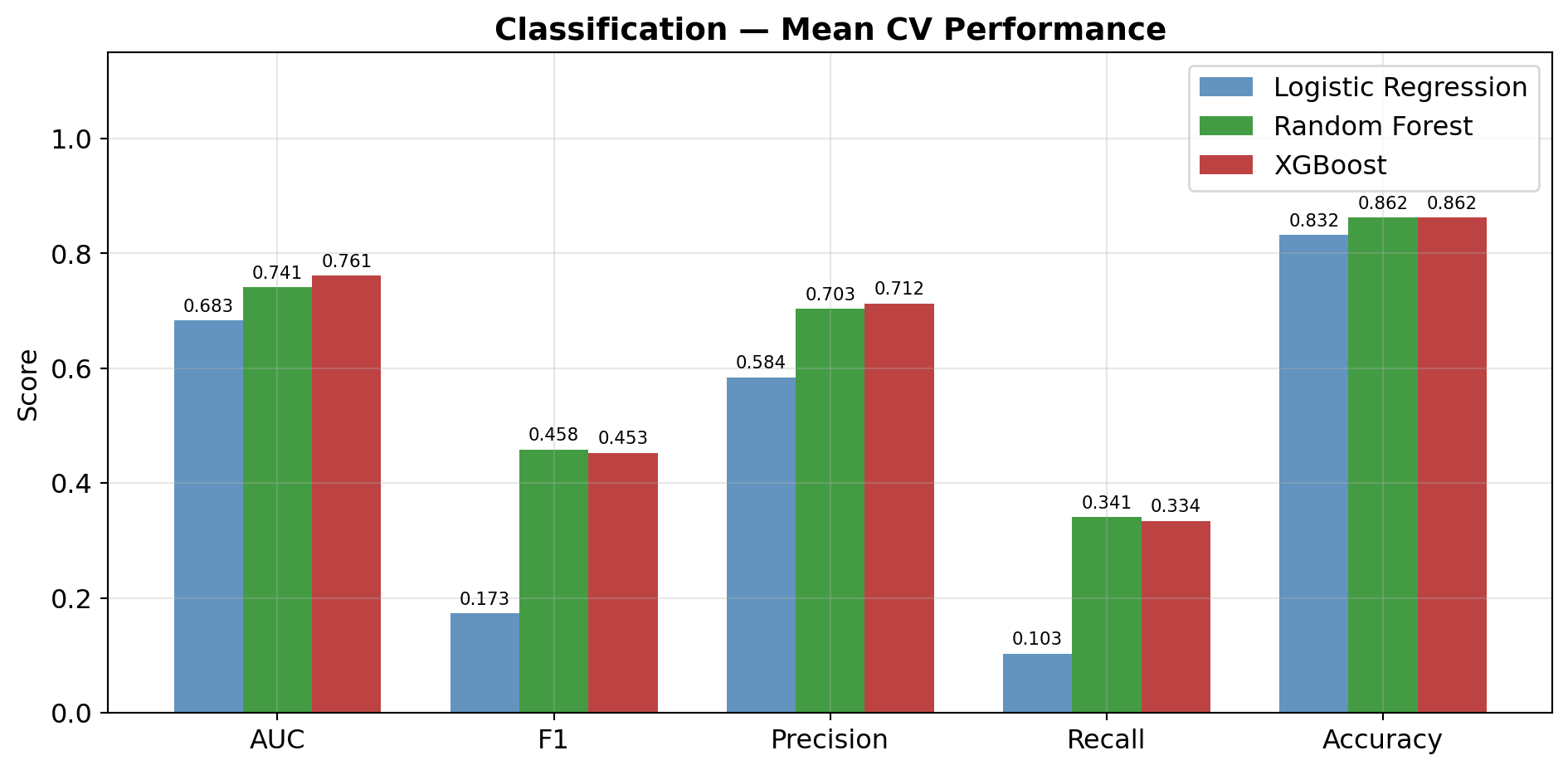
Cross-Validation Results

cv_cls_mean = (
    cv_all[cv_all["Task"] == "Classification"]
    .groupby("Model", as_index=False)[["AUC", "F1", "Precision", "Recall", "Accuracy"]]
    .mean().round(4)
)
cv_reg_mean = (
    cv_all[cv_all["Task"] == "Regression"]
    .groupby("Model", as_index=False)[["MAE", "RMSE"]]
    .mean().round(2)
)
safe_display(cv_cls_mean, "Classification — Mean CV Performance")
safe_display(cv_reg_mean, "Regression — Mean CV Performance")
Table 2: Classification — Mean CV Performance
Model AUC F1 Precision Recall Accuracy
Logistic Regression 0.682800 0.172900 0.583600 0.103100 0.831900
Random Forest 0.740600 0.458200 0.702900 0.340800 0.861800
XGBoost 0.760700 0.452700 0.712100 0.334200 0.862000
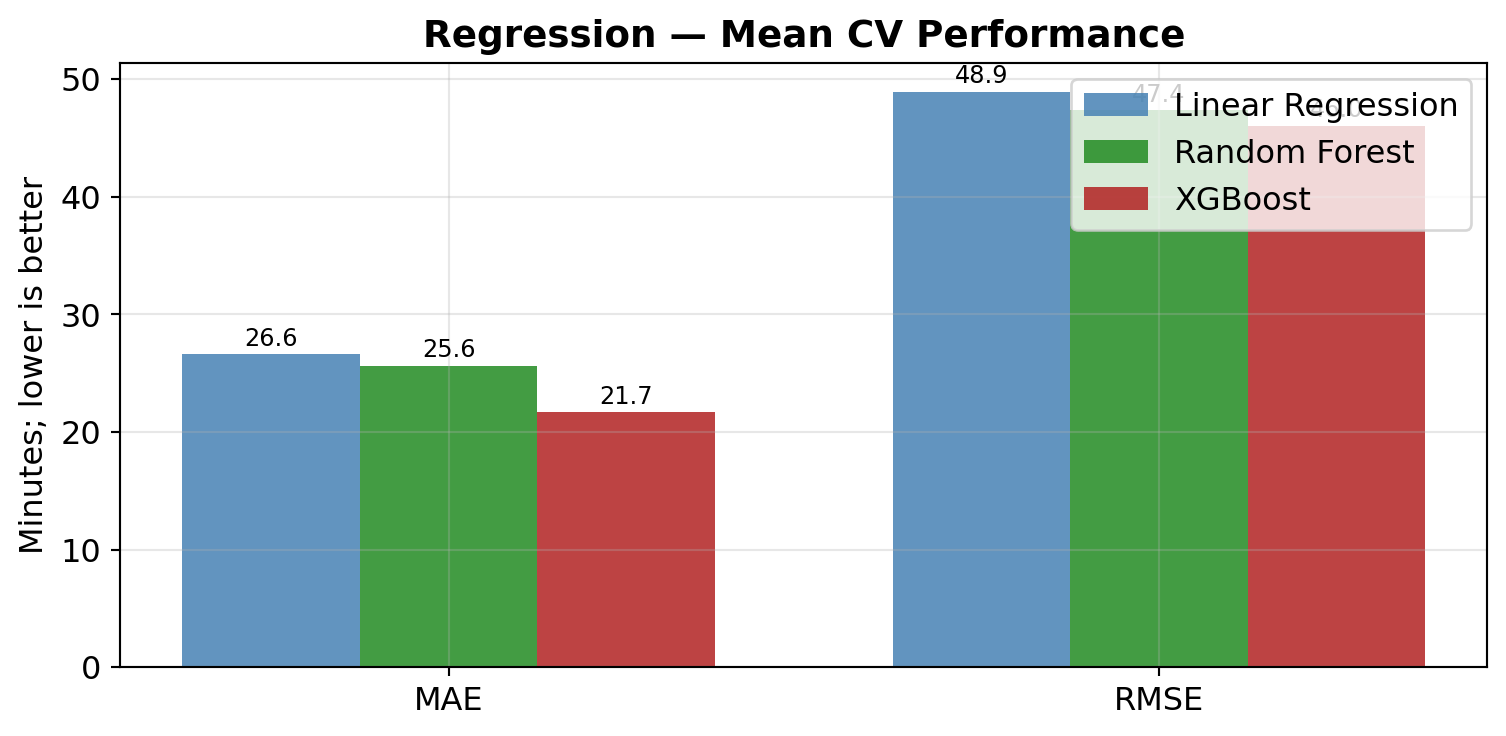
Table 3: Regression — Mean CV Performance
Model MAE RMSE
Linear Regression 26.600000 48.920000
Random Forest 25.630000 47.370000
XGBoost 21.700000 46.040000
fig, ax = plt.subplots(figsize=(10, 5))
metrics = ["AUC", "F1", "Precision", "Recall", "Accuracy"]
x = np.arange(len(metrics)); width = 0.25
for j, model in enumerate(cv_cls_mean["Model"].tolist()):
    vals = cv_cls_mean.loc[cv_cls_mean["Model"] == model, metrics].values[0]
    bars = ax.bar(x + j*width - width, vals, width, label=model, color=COLORS.get(model, "gray"), alpha=0.85)
    for bar, v in zip(bars, vals):
        ax.text(bar.get_x() + bar.get_width()/2, bar.get_height() + 0.01,
                f"{v:.3f}", ha="center", va="bottom", fontsize=8)
ax.set_xticks(x); ax.set_xticklabels(metrics); ax.set_ylim(0, 1.15)
ax.set_title("Classification — Mean CV Performance"); ax.set_ylabel("Score")
ax.legend(loc="upper right"); plt.tight_layout(); plt.show()

Mean cross-validation classification metrics across five expanding folds
fig, ax = plt.subplots(figsize=(8, 4))
metrics = ["MAE", "RMSE"]; x = np.arange(len(metrics)); width = 0.25
for j, model in enumerate(cv_reg_mean["Model"].tolist()):
    vals = cv_reg_mean.loc[cv_reg_mean["Model"] == model, metrics].values[0]
    bars = ax.bar(x + j*width - width, vals, width, label=model, color=COLORS.get(model, "gray"), alpha=0.85)
    for bar, v in zip(bars, vals):
        ax.text(bar.get_x() + bar.get_width()/2, bar.get_height() + 0.3,
                f"{v:.1f}", ha="center", va="bottom", fontsize=9)
ax.set_xticks(x); ax.set_xticklabels(metrics)
ax.set_title("Regression — Mean CV Performance"); ax.set_ylabel("Minutes; lower is better")
ax.legend(loc="upper right"); plt.tight_layout(); plt.show()

Mean cross-validation regression metrics across five expanding folds

Final Holdout Evaluation: December

RF_FINAL_SAMPLE  = 50_000;  RF_FINAL_TREES   = 200
XGB_FINAL_ROUNDS = 200;     XGB_FINAL_SAMPLE = 80_000
LR_FINAL_SAMPLE  = 200_000
HOLDOUT_CACHE = Path("data/holdout_models_r_aligned.pkl")

if HOLDOUT_CACHE.exists():
    print(f"Loading holdout models/predictions from cache: {HOLDOUT_CACHE}")
    with open(HOLDOUT_CACHE, "rb") as f:
        hm = pickle.load(f)
    globals().update(hm)
    # Reconcile FEATURE_COLS against the cached model — caches may have been built separately
    FEATURE_COLS = resolve_feature_names(final_rf_cls, FEATURE_COLS)
    print(f"Holdout cache loaded. Using {len(FEATURE_COLS)} features.")
else:
    print("Training final models on full Jan–Nov data...")
    rng = np.random.default_rng(RANDOM_STATE)
    tr_X     = train_cv_df[FEATURE_COLS].to_numpy(dtype=np.float32)
    ho_X     = holdout_df[FEATURE_COLS].to_numpy(dtype=np.float32)
    tr_y_cls = train_cv_df[TARGET_CLS].to_numpy(dtype=int);   ho_y_cls = holdout_df[TARGET_CLS].to_numpy(dtype=int)
    tr_y_reg = train_cv_df[TARGET_REG].to_numpy(dtype=float); ho_y_reg = holdout_df[TARGET_REG].to_numpy(dtype=float)
    rf_idx  = sample_idx(len(tr_X), RF_FINAL_SAMPLE,  rng)
    xgb_idx = sample_idx(len(tr_X), XGB_FINAL_SAMPLE, rng)
    lr_idx  = sample_idx(len(tr_X), LR_FINAL_SAMPLE,  rng)

    print("  Logistic Regression...", end="", flush=True); t0 = time.time()
    final_lr = fit_logistic_unregularized(tr_X[lr_idx], tr_y_cls[lr_idx])
    ho_lr_prob = final_lr.predict_proba(ho_X)[:, 1]; ho_lr_pred = (ho_lr_prob > 0.5).astype(int)
    print(f" done ({time.time()-t0:.1f}s)")

    print("  RF Classification...", end="", flush=True); t0 = time.time()
    final_rf_cls = RandomForestClassifier(n_estimators=RF_FINAL_TREES, max_features="sqrt",
                                          bootstrap=True, n_jobs=N_JOBS, random_state=RANDOM_STATE)
    final_rf_cls.fit(tr_X[rf_idx], tr_y_cls[rf_idx])
    ho_rf_prob = final_rf_cls.predict_proba(ho_X)[:, 1]; ho_rf_pred = final_rf_cls.predict(ho_X)
    print(f" done ({time.time()-t0:.1f}s)")

    print("  XGBoost Classification...", end="", flush=True); t0 = time.time()
    final_xgb_cls = xgb.XGBClassifier(
        objective="binary:logistic", eval_metric="auc",
        n_estimators=XGB_FINAL_ROUNDS, learning_rate=0.1, max_depth=6,
        subsample=0.8, colsample_bytree=0.8, tree_method="hist",
        n_jobs=N_JOBS, random_state=RANDOM_STATE, verbosity=0)
    final_xgb_cls.fit(tr_X[xgb_idx], tr_y_cls[xgb_idx])
    ho_xgb_prob = final_xgb_cls.predict_proba(ho_X)[:, 1]; ho_xgb_pred = (ho_xgb_prob > 0.5).astype(int)
    print(f" done ({time.time()-t0:.1f}s)")

    print("  Linear Regression...", end="", flush=True); t0 = time.time()
    final_lm = LinearRegression(n_jobs=N_JOBS)
    final_lm.fit(tr_X[lr_idx], tr_y_reg[lr_idx]); ho_lm_pred = final_lm.predict(ho_X)
    print(f" done ({time.time()-t0:.1f}s)")

    print("  RF Regression...", end="", flush=True); t0 = time.time()
    final_rf_reg = RandomForestRegressor(
        n_estimators=RF_FINAL_TREES, max_features=max(1, len(FEATURE_COLS) // 3),
        bootstrap=True, n_jobs=N_JOBS, random_state=RANDOM_STATE)
    final_rf_reg.fit(tr_X[rf_idx], tr_y_reg[rf_idx]); ho_rf_reg_pred = final_rf_reg.predict(ho_X)
    print(f" done ({time.time()-t0:.1f}s)")

    print("  XGBoost Regression...", end="", flush=True); t0 = time.time()
    final_xgb_reg = xgb.XGBRegressor(
        objective="reg:squarederror", n_estimators=XGB_FINAL_ROUNDS,
        learning_rate=0.1, max_depth=6, subsample=0.8, colsample_bytree=0.8,
        tree_method="hist", n_jobs=N_JOBS, random_state=RANDOM_STATE, verbosity=0)
    final_xgb_reg.fit(tr_X[xgb_idx], tr_y_reg[xgb_idx]); ho_xgb_reg_pred = final_xgb_reg.predict(ho_X)
    print(f" done ({time.time()-t0:.1f}s)")

    with open(HOLDOUT_CACHE, "wb") as f:
        pickle.dump(dict(
            final_lr=final_lr, final_rf_cls=final_rf_cls, final_xgb_cls=final_xgb_cls,
            final_lm=final_lm, final_rf_reg=final_rf_reg, final_xgb_reg=final_xgb_reg,
            ho_lr_prob=ho_lr_prob, ho_lr_pred=ho_lr_pred,
            ho_rf_prob=ho_rf_prob, ho_rf_pred=ho_rf_pred,
            ho_xgb_prob=ho_xgb_prob, ho_xgb_pred=ho_xgb_pred,
            ho_lm_pred=ho_lm_pred, ho_rf_reg_pred=ho_rf_reg_pred,
            ho_xgb_reg_pred=ho_xgb_reg_pred, ho_y_cls=ho_y_cls, ho_y_reg=ho_y_reg,
        ), f)
    print(f"Holdout cache written to {HOLDOUT_CACHE}")
Loading holdout models/predictions from cache: data/holdout_models_r_aligned.pkl
Holdout cache loaded. Using 24 features.
def cls_metrics(name, prob, pred, y_true):
    row = cls_row(0, name, prob, pred, y_true, np.nan)
    return {"Model": name, "AUC": round(row["AUC"], 4), "F1": round(row["F1"], 4),
            "Precision": round(row["Precision"], 4), "Recall": round(row["Recall"], 4),
            "Accuracy": round(row["Accuracy"], 4)}

holdout_cls = pd.DataFrame([
    cls_metrics("Logistic Regression", ho_lr_prob,  ho_lr_pred,  ho_y_cls),
    cls_metrics("Random Forest",       ho_rf_prob,  ho_rf_pred,  ho_y_cls),
    cls_metrics("XGBoost",             ho_xgb_prob, ho_xgb_pred, ho_y_cls),
])
holdout_reg = pd.DataFrame([
    {"Model": "Linear Regression", "MAE": round(calc_mae(ho_y_reg, ho_lm_pred), 2),     "RMSE": round(calc_rmse(ho_y_reg, ho_lm_pred), 2)},
    {"Model": "Random Forest",     "MAE": round(calc_mae(ho_y_reg, ho_rf_reg_pred), 2),  "RMSE": round(calc_rmse(ho_y_reg, ho_rf_reg_pred), 2)},
    {"Model": "XGBoost",           "MAE": round(calc_mae(ho_y_reg, ho_xgb_reg_pred), 2), "RMSE": round(calc_rmse(ho_y_reg, ho_xgb_reg_pred), 2)},
])
safe_display(holdout_cls, "Holdout December — Classification Results")
safe_display(holdout_reg, "Holdout December — Regression Results")
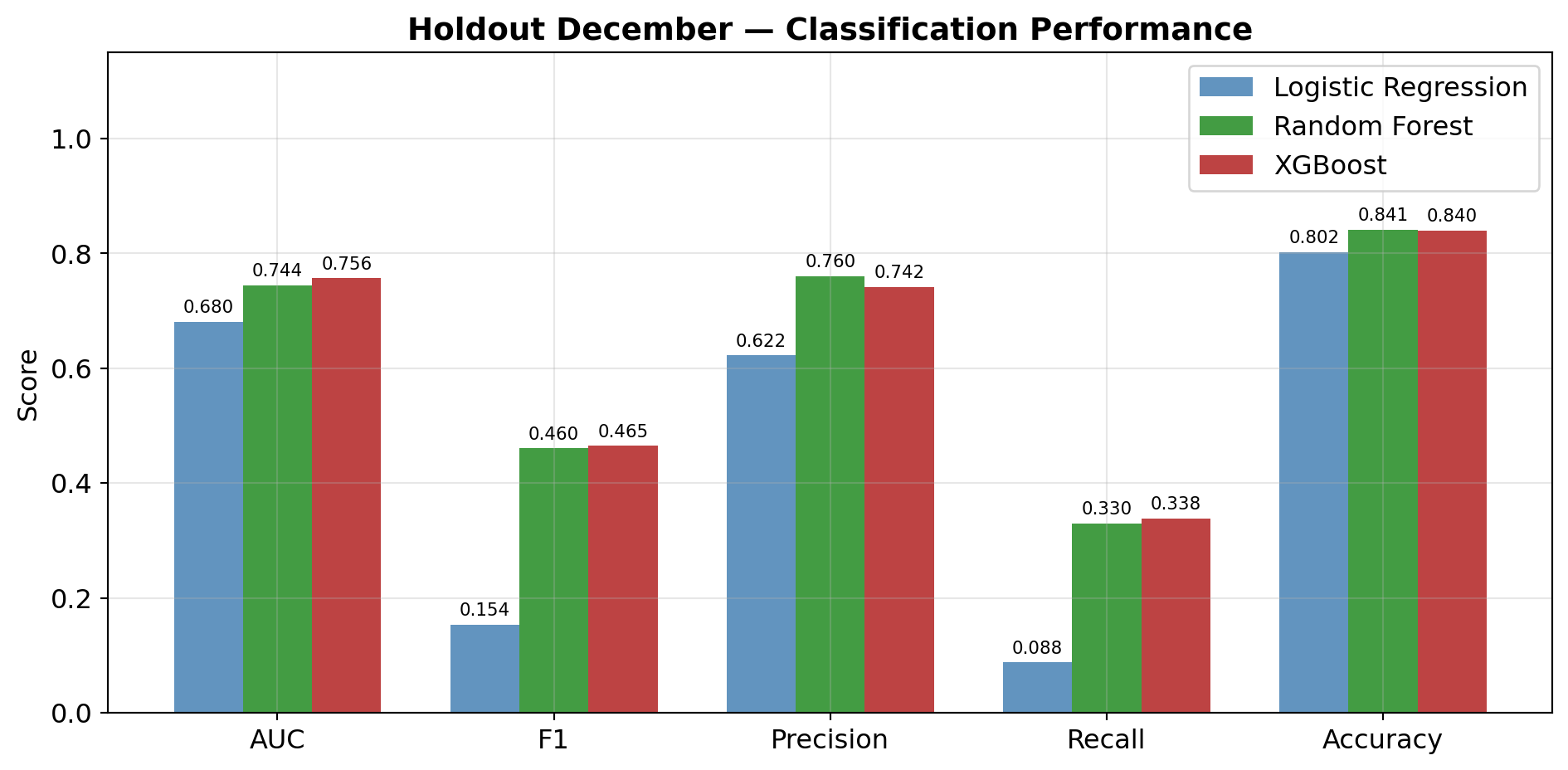
Table 4: Holdout December — Classification Results
Model AUC F1 Precision Recall Accuracy
Logistic Regression 0.680500 0.153700 0.622200 0.087700 0.801900
Random Forest 0.744000 0.460300 0.760100 0.330100 0.841200
XGBoost 0.756500 0.464600 0.741700 0.338200 0.840000
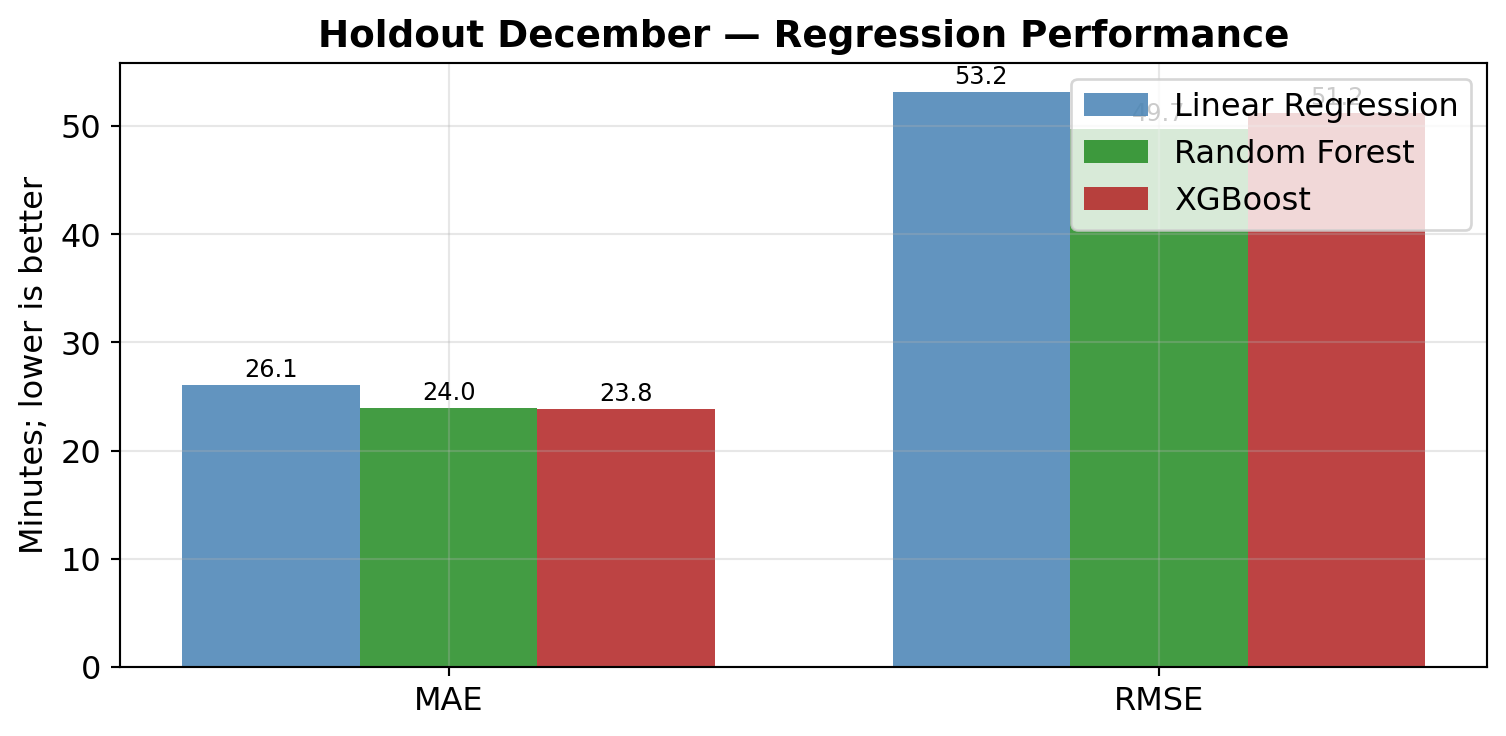
Table 5: Holdout December — Regression Results
Model MAE RMSE
Linear Regression 26.110000 53.170000
Random Forest 23.970000 49.690000
XGBoost 23.820000 51.190000

Visualizations

fig, ax = plt.subplots(figsize=(10, 5))
metrics = ["AUC", "F1", "Precision", "Recall", "Accuracy"]; x = np.arange(len(metrics)); width = 0.25
for j, model in enumerate(holdout_cls["Model"].tolist()):
    vals = holdout_cls.loc[holdout_cls["Model"] == model, metrics].values[0]
    bars = ax.bar(x + j*width - width, vals, width, label=model, color=COLORS.get(model, "gray"), alpha=0.85)
    for bar, v in zip(bars, vals):
        ax.text(bar.get_x() + bar.get_width()/2, bar.get_height() + 0.01,
                f"{v:.3f}", ha="center", va="bottom", fontsize=8)
ax.set_xticks(x); ax.set_xticklabels(metrics); ax.set_ylim(0, 1.15)
ax.set_title("Holdout December — Classification Performance"); ax.set_ylabel("Score")
ax.legend(loc="upper right"); plt.tight_layout(); plt.show()

December holdout classification performance by model
fig, ax = plt.subplots(figsize=(8, 4))
metrics = ["MAE", "RMSE"]; x = np.arange(len(metrics)); width = 0.25
for j, model in enumerate(holdout_reg["Model"].tolist()):
    vals = holdout_reg.loc[holdout_reg["Model"] == model, metrics].values[0]
    bars = ax.bar(x + j*width - width, vals, width, label=model, color=COLORS.get(model, "gray"), alpha=0.85)
    for bar, v in zip(bars, vals):
        ax.text(bar.get_x() + bar.get_width()/2, bar.get_height() + 0.3,
                f"{v:.1f}", ha="center", va="bottom", fontsize=9)
ax.set_xticks(x); ax.set_xticklabels(metrics)
ax.set_title("Holdout December — Regression Performance"); ax.set_ylabel("Minutes; lower is better")
ax.legend(loc="upper right"); plt.tight_layout(); plt.show()

December holdout regression performance by model
fig, ax = plt.subplots(figsize=(7, 6))
for name, prob in [("Logistic Regression", ho_lr_prob),
                   ("Random Forest",       ho_rf_prob),
                   ("XGBoost",             ho_xgb_prob)]:
    fpr, tpr, _ = roc_curve(ho_y_cls, prob)
    ax.plot(fpr, tpr, label=f"{name} AUC={roc_auc_score(ho_y_cls, prob):.3f}", linewidth=2)
ax.plot([0, 1], [0, 1], "--", color="gray", linewidth=1)
ax.set_xlabel("False Positive Rate"); ax.set_ylabel("True Positive Rate")
ax.set_title("ROC Curves — December Holdout"); ax.legend(loc="lower right")
plt.tight_layout(); plt.show()

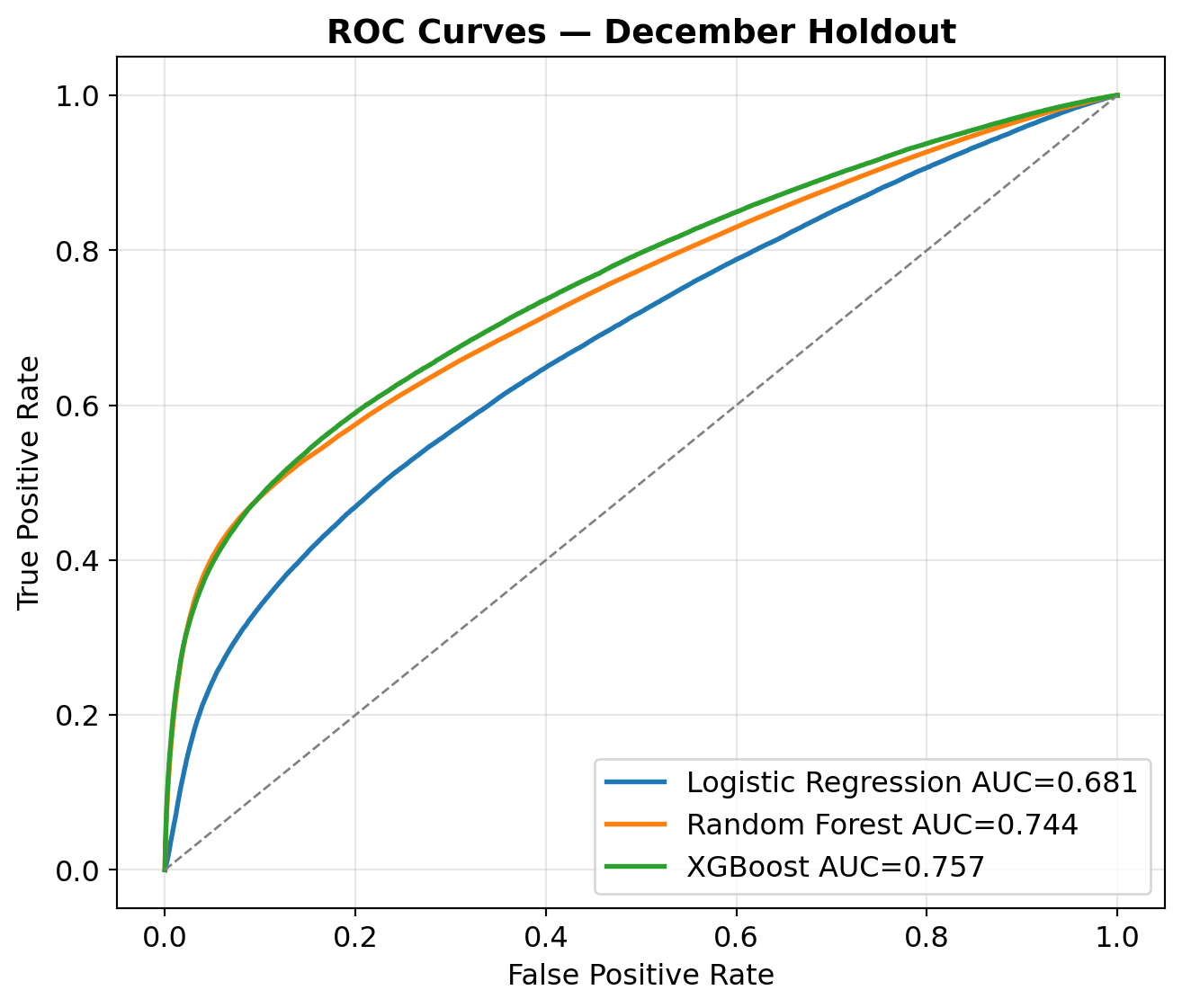
ROC curves for all classifiers on the December holdout
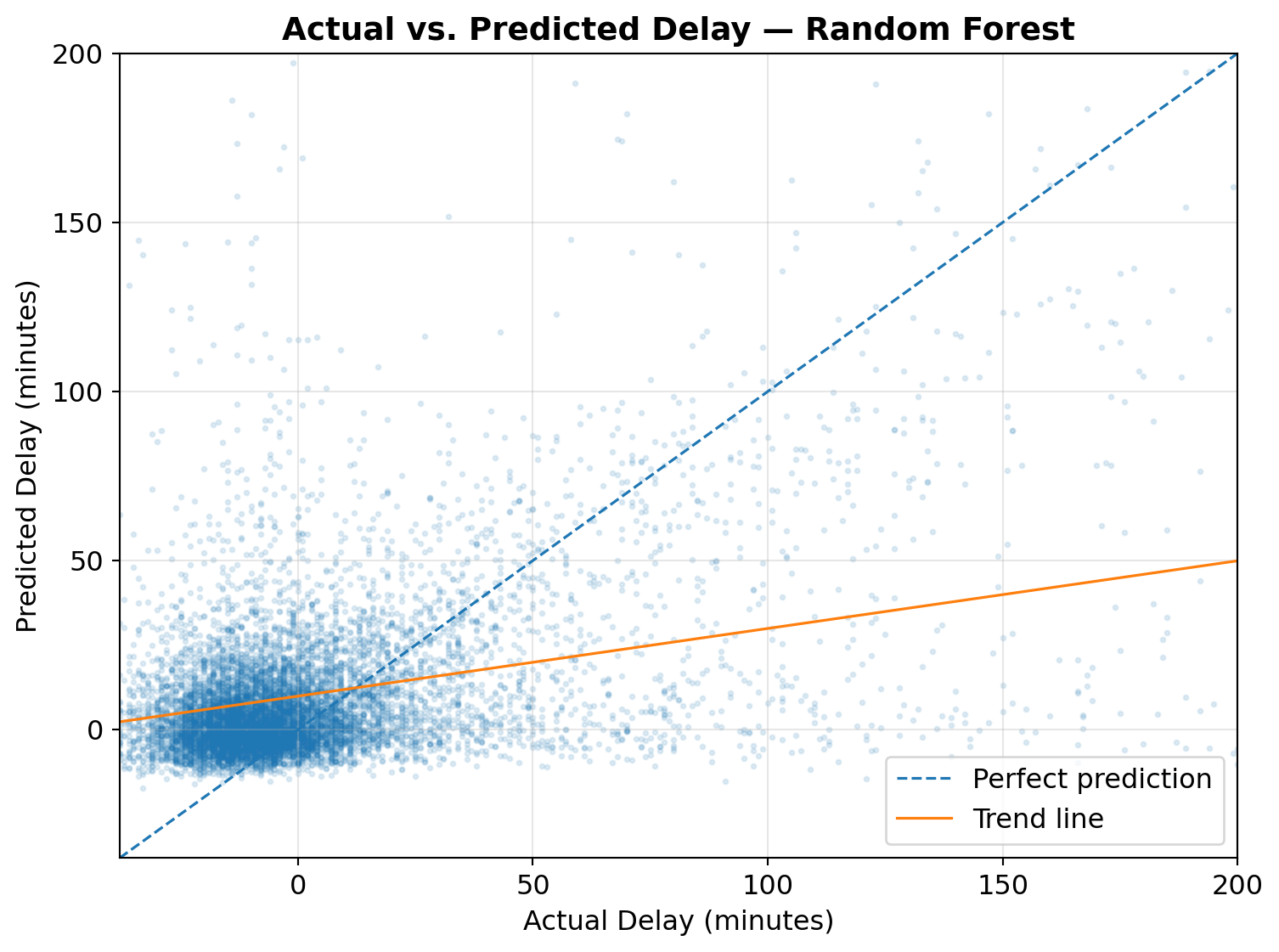
best_reg_model = holdout_reg.loc[holdout_reg["RMSE"].idxmin(), "Model"]
best_pred_map  = {"Linear Regression": ho_lm_pred, "Random Forest": ho_rf_reg_pred, "XGBoost": ho_xgb_reg_pred}
best_pred = best_pred_map[best_reg_model]
rng = np.random.default_rng(RANDOM_STATE)
idx = rng.choice(len(ho_y_reg), min(10_000, len(ho_y_reg)), replace=False)
actual_sample = ho_y_reg[idx]; pred_sample = best_pred[idx]
p1_a, p99_a = np.percentile(actual_sample, [1, 99]); p1_p, p99_p = np.percentile(pred_sample, [1, 99])
lims = [min(p1_a, p1_p), max(p99_a, p99_p)]
fig, ax = plt.subplots(figsize=(8, 6))
ax.scatter(actual_sample, pred_sample, alpha=0.12, s=4)
ax.plot(lims, lims, "--", linewidth=1.2, label="Perfect prediction")
m, b = np.polyfit(actual_sample, pred_sample, 1)
x_line = np.linspace(lims[0], lims[1], 200)
ax.plot(x_line, m*x_line + b, linewidth=1.2, label="Trend line")
ax.set_xlim(lims); ax.set_ylim(lims)
ax.set_xlabel("Actual Delay (minutes)"); ax.set_ylabel("Predicted Delay (minutes)")
ax.set_title(f"Actual vs. Predicted Delay — {best_reg_model}"); ax.legend()
plt.tight_layout(); plt.show()

Actual vs. predicted delay minutes for the best regression model (10 000-flight sample)
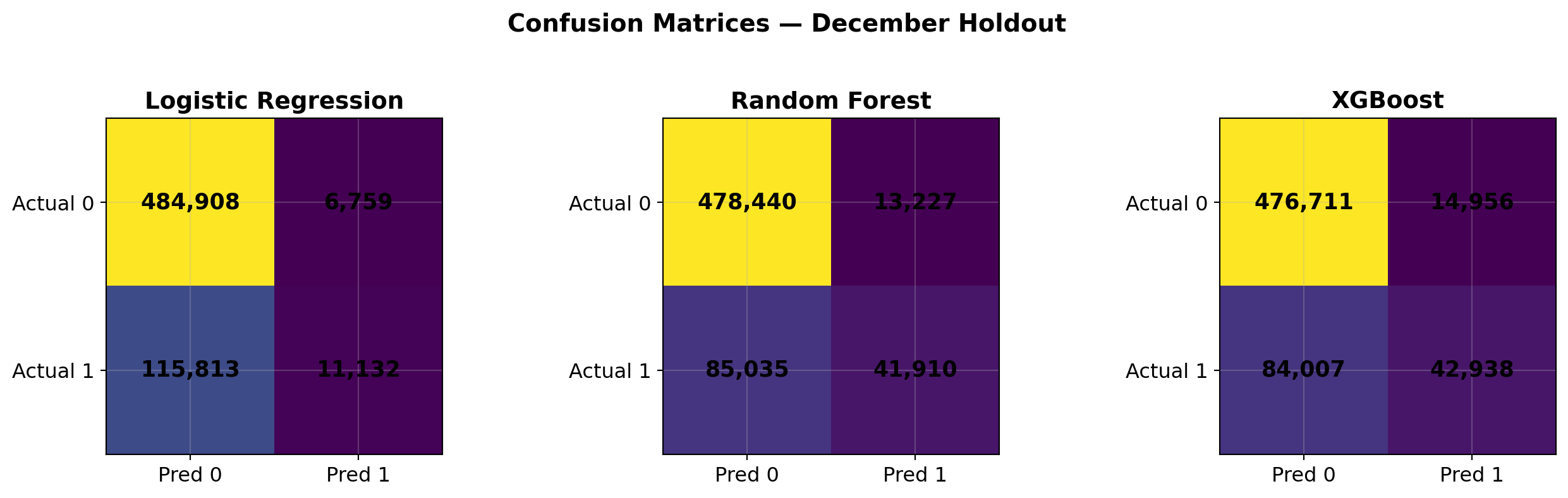
fig, axes = plt.subplots(1, 3, figsize=(14, 4))
fig.suptitle("Confusion Matrices — December Holdout", fontweight="bold", y=1.02)
for ax, (name, pred) in zip(axes, [("Logistic Regression", ho_lr_pred),
                                    ("Random Forest",       ho_rf_pred),
                                    ("XGBoost",             ho_xgb_pred)]):
    cm = confusion_matrix(ho_y_cls, pred, labels=[0, 1]); ax.imshow(cm)
    for i in range(2):
        for j in range(2):
            ax.text(j, i, f"{cm[i,j]:,}", ha="center", va="center", fontsize=13, fontweight="bold")
    ax.set_xticks([0,1]); ax.set_yticks([0,1])
    ax.set_xticklabels(["Pred 0","Pred 1"]); ax.set_yticklabels(["Actual 0","Actual 1"])
    ax.set_title(name)
plt.tight_layout(); plt.show()

Confusion matrices for all classifiers on the December holdout

Feature Importance

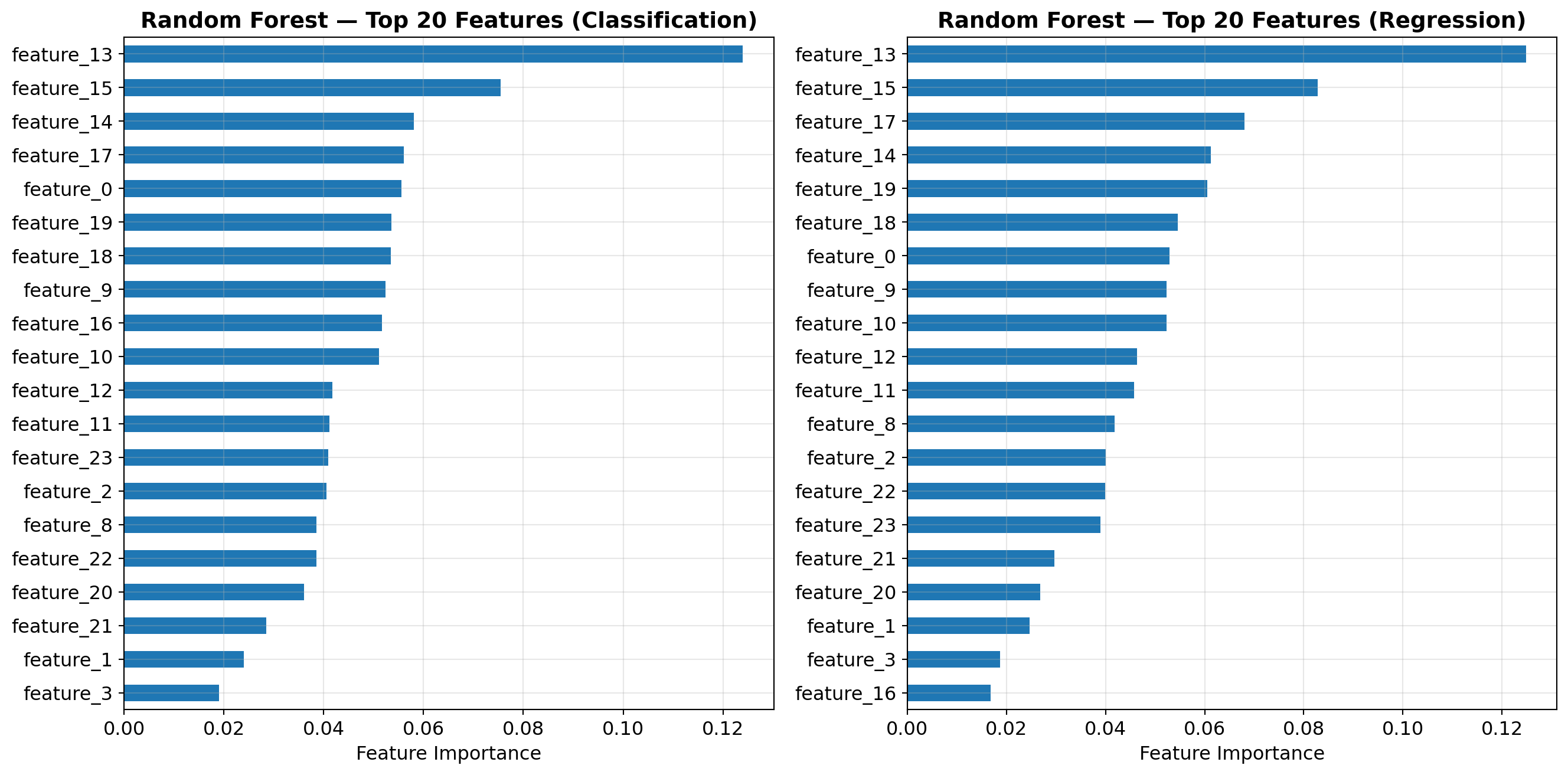
fig, axes = plt.subplots(1, 2, figsize=(14, 7))
for ax, model, title in [(axes[0], final_rf_cls, "Classification"),
                          (axes[1], final_rf_reg, "Regression")]:
    feat_names = resolve_feature_names(model, FEATURE_COLS)
    imp = pd.Series(model.feature_importances_, index=feat_names)
    imp.nlargest(20).sort_values().plot.barh(ax=ax)
    ax.set_title(f"Random Forest — Top 20 Features ({title})")
    ax.set_xlabel("Feature Importance")
plt.tight_layout(); plt.show()

Top 20 Random Forest feature importances for classification and regression
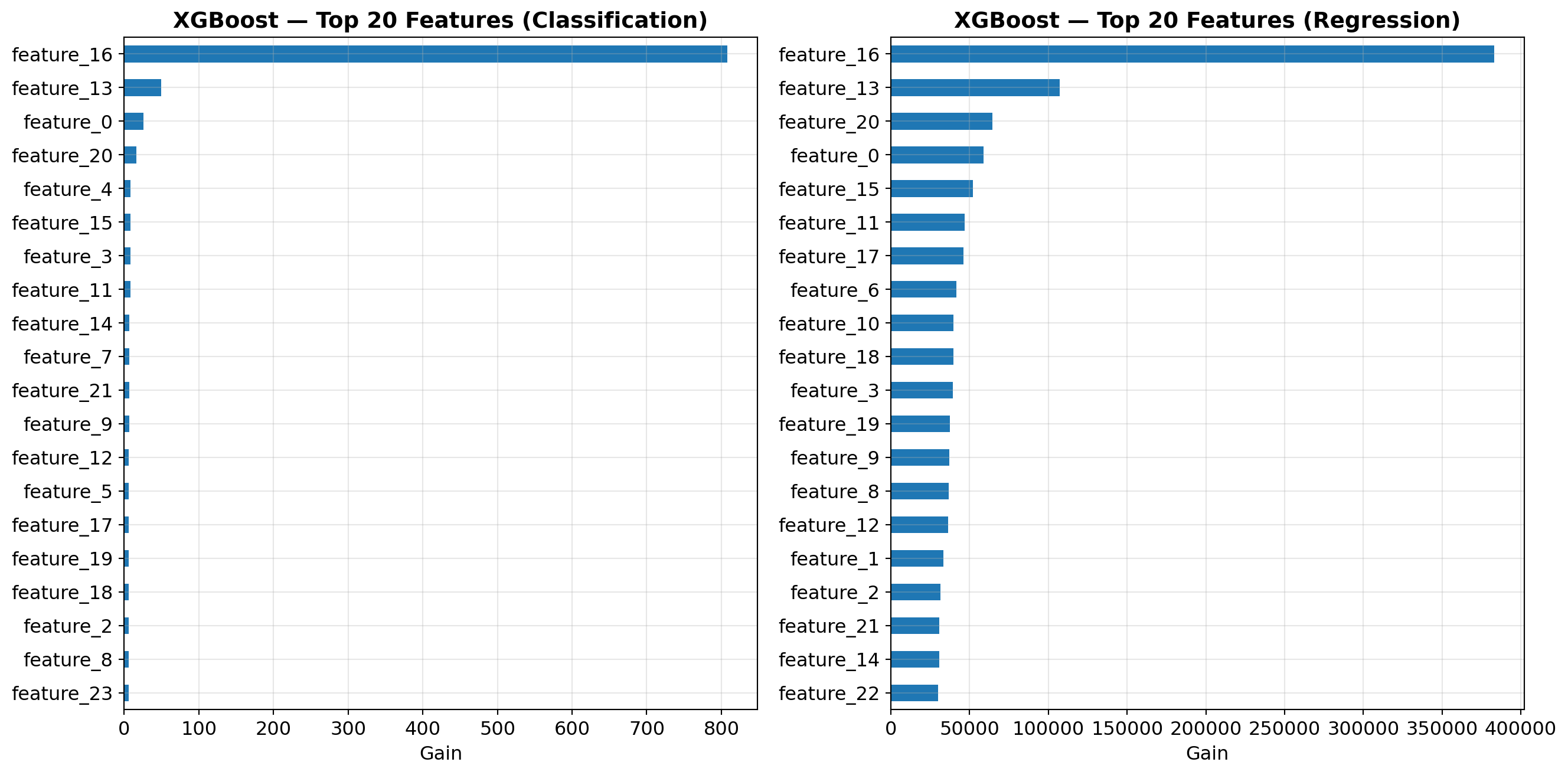
fig, axes = plt.subplots(1, 2, figsize=(14, 7))
for ax, booster_model, title in [(axes[0], final_xgb_cls, "Classification"),
                                   (axes[1], final_xgb_reg, "Regression")]:
    booster = booster_model.get_booster()
    score   = booster.get_score(importance_type="gain")
    imp = pd.Series({FEATURE_COLS[int(k[1:])]: v for k, v in score.items() if k.startswith("f")})
    imp.nlargest(20).sort_values().plot.barh(ax=ax)
    ax.set_title(f"XGBoost — Top 20 Features ({title})"); ax.set_xlabel("Gain")
plt.tight_layout(); plt.show()

Top 20 XGBoost feature importances (gain) for classification and regression

Key Insights

total_time     = round(time.time() - GLOBAL_START, 1)
best_cls_model = holdout_cls.loc[holdout_cls["AUC"].idxmax(),  "Model"]
best_reg_model = holdout_reg.loc[holdout_reg["RMSE"].idxmin(), "Model"]
insights = pd.DataFrame({
    "Item": ["Best Classifier (AUC)", "Best Classifier AUC", "Best Regressor (RMSE)",
             "Best Regressor RMSE", "Total Features", "Training Rows (Jan–Nov)",
             "Holdout Rows (Dec)", "CV Folds", "Total Pipeline Time"],
    "Value": [
        best_cls_model, holdout_cls.loc[holdout_cls["AUC"].idxmax(), "AUC"],
        best_reg_model, f"{holdout_reg.loc[holdout_reg['RMSE'].idxmin(), 'RMSE']} min",
        len(FEATURE_COLS), f"{len(train_cv_df):,}", f"{len(holdout_df):,}",
        len(CV_FOLDS), f"{total_time} seconds",
    ],
})
safe_display(insights, "Pipeline Summary")
Table 6: Pipeline Summary
Item Value
Best Classifier (AUC) XGBoost
Best Classifier AUC 0.756500
Best Regressor (RMSE) Random Forest
Best Regressor RMSE 49.69 min
Total Features 24
Training Rows (Jan–Nov) 6,649,620
Holdout Rows (Dec) 618,612
CV Folds 5
Total Pipeline Time 8.1 seconds

For full project details see: github.com/jonathanwilsonami/OR568_ML_Project