Phase 2: XGBoost with Weather & Propagation Features

Schedule, weather, and aircraft rotation features on 2019 U.S. domestic flights

Published

May 6, 2026

Overview

This phase extends the Phase 1 baseline with three progressively richer XGBoost feature sets:

Model Features
xgb_schedule Schedule / calendar only
xgb_weather_traffic Schedule + weather + route traffic
xgb_full_propagation All above + aircraft rotation / delay propagation

Evaluation follows the same expanding-window monthly CV and December holdout as Phase 1.

Note

This code does not run the ml-pipeline. The ml-pipeline was used to train the 10 year model and uses a much larger data set. If you would like to run that model see the ml_pipeline directory in the code base. Read the README to learn how to run the ml-pipeline. See the config.py if you wish to toggle the various pipeline parameters.

Variables and numbers in this code will not match with what is in the paper. However, the same process was followed for build the model what was discussed in the paper just a much smaller scale. The purpose of this page is to demonstrate the methodology.

Setup

Show code
from pathlib import Path
import sys
import importlib
import warnings
warnings.filterwarnings("ignore")

import time
import numpy as np
import pandas as pd
import polars as pl
import matplotlib.pyplot as plt
import matplotlib
matplotlib.rcParams['figure.dpi'] = 120

from sklearn.metrics import (
    roc_auc_score, f1_score, precision_score, recall_score,
    accuracy_score, mean_absolute_error, mean_squared_error, roc_curve,
)
from xgboost import XGBClassifier, XGBRegressor

def timer_log(label, start_time):
    elapsed = time.perf_counter() - start_time
    print(f"[TIMER] {label}: {elapsed:.2f}s")

Data Loading

Show code
t0 = time.perf_counter()

pl.Config.set_tbl_rows(1000)
pl.Config.set_tbl_cols(100)
pl.Config.set_tbl_width_chars(200)

# Quarto sets cwd to execute-dir (project root).
# The shared-notebooks tree lives one level up from the project root.
# Adjust SHARED_NOTEBOOKS_PATH if your layout differs.
SHARED_NOTEBOOKS_PATH = Path(__file__).resolve().parent.parent / "shared-notebooks" \
    if "__file__" in dir() else Path.cwd().parent / "shared-notebooks"

# Fallback: walk upward looking for shared-notebooks (works when __file__ is unavailable)
if not SHARED_NOTEBOOKS_PATH.exists():
    _cur = Path.cwd()
    while _cur != _cur.parent:
        if (_cur / "shared-notebooks").exists():
            SHARED_NOTEBOOKS_PATH = _cur / "shared-notebooks"
            break
        _cur = _cur.parent

if not SHARED_NOTEBOOKS_PATH.exists():
    raise RuntimeError(
        f"Could not locate shared-notebooks. cwd={Path.cwd()}. "
        "Set SHARED_NOTEBOOKS_PATH manually or check your project layout."
    )

utils_path = SHARED_NOTEBOOKS_PATH / "common_utils" / "python"
if str(utils_path) not in sys.path:
    sys.path.append(str(utils_path))

import load_flight_data
importlib.reload(load_flight_data)

lf = load_flight_data.load_flight_data(file_name="flights_canonical_2019.parquet")

timer_log("Load data", t0)
[TIMER] Load data: 0.05s

Feature Engineering

Features are grouped into:

  • Calendar / schedule — departure hour, weekday, month, holiday proximity, schedule block
  • Weather — temperature, wind speed/direction, ceiling height at origin and destination
  • Traffic — route frequency, airport flight volumes
  • Rotation / propagation — turnaround time, cumulative aircraft delay, 1- and 2-hop lag features
Warning

Leakage guard: Raw cum_arr_delay_aircraft_day is not used as a feature because it can include the current flight’s own arrival delay. The model uses prior_cum_arr_delay_aircraft_day, shifted by one flight within each (tail_number, flight_date) group.

Show code
t0 = time.perf_counter()

RAW_FEATURES = [
    "flight_id", "tail_number", "reporting_airline", "origin", "dest",
    "route_key", "distance", "flight_date",
    "dep_hour_local", "dep_weekday_local", "dep_month_local",
    "dep_ts_sched_utc", "dep_ts_actual_utc", "arr_ts_sched_utc", "arr_ts_actual_utc",
    "dep_temp_c", "dep_wind_speed_m_s", "dep_wind_dir_deg", "dep_ceiling_height_m",
    "arr_temp_c", "arr_wind_speed_m_s", "arr_wind_dir_deg", "arr_ceiling_height_m",
    "prev_flight_id_same_tail", "next_flight_id_same_tail",
    "prev_origin", "prev_dest", "next_origin", "next_dest",
    "prev_arr_ts_actual_utc", "next_dep_ts_actual_utc",
    "dep_delay", "dep_del15", "arr_delay", "arr_del15",
    "prev_arr_delay", "prev_dep_delay", "next_arr_delay", "next_dep_delay",
    "prev_arr_del15", "prev_dep_del15", "next_dep_del15", "next_arr_del15",
    "prev_arr_late_15", "prev_dep_late_15", "next_arr_late_15", "next_dep_late_15",
    "turnaround_minutes", "next_turnaround_minutes",
    "rotation_continuity_flag", "next_rotation_continuity_flag",
    "aircraft_leg_number_day", "cum_dep_delay_aircraft_day", "cum_arr_delay_aircraft_day",
    "is_cancelled", "is_diverted", "crs_elapsed_time", "dep_time_blk", "arr_time_blk",
]

US_HOLIDAYS_2019 = [
    "2019-01-01", "2019-01-21", "2019-02-18", "2019-05-27",
    "2019-07-04", "2019-09-02", "2019-10-14", "2019-11-11",
    "2019-11-28", "2019-12-25",
]

ml_lf = (
    lf.select(RAW_FEATURES)
    .filter(
        (pl.col("is_cancelled") == 0) & (pl.col("is_diverted") == 0) &
        pl.col("arr_del15").is_not_null() & pl.col("tail_number").is_not_null() &
        pl.col("dep_ts_actual_utc").is_not_null() & pl.col("arr_ts_actual_utc").is_not_null()
    )
)

lf_features = (
    ml_lf
    .with_columns([
        pl.col("flight_date").cast(pl.Date),
        pl.col("dep_ts_actual_utc").cast(pl.Datetime),
        pl.col("arr_ts_actual_utc").cast(pl.Datetime),
        pl.col("dep_month_local").cast(pl.Int8),
    ])
    .with_columns([
        pl.when(pl.col("dep_hour_local") < 6).then(1)
        .when(pl.col("dep_hour_local") < 11).then(2)
        .when(pl.col("dep_hour_local") < 14).then(3)
        .when(pl.col("dep_hour_local") < 18).then(4)
        .when(pl.col("dep_hour_local") < 21).then(5)
        .otherwise(6).alias("dep_time_bucket"),

        pl.col("dep_weekday_local").is_in([6, 7]).cast(pl.Int8).alias("is_weekend"),
        pl.col("flight_date").cast(pl.Utf8).is_in(US_HOLIDAYS_2019).cast(pl.Int8).alias("is_holiday"),

        pl.min_horizontal([
            (pl.col("flight_date").cast(pl.Date) - pl.lit(h).str.strptime(pl.Date))
            .abs().dt.total_days()
            for h in US_HOLIDAYS_2019
        ]).alias("days_to_nearest_holiday"),

        pl.len().over("route_key").alias("route_frequency"),
        pl.len().over("origin").alias("origin_flight_volume"),
        pl.len().over("dest").alias("dest_flight_volume"),
        (pl.col("prev_arr_delay") > 15).cast(pl.Int8).alias("prev_arr_delayed_flag"),
        (pl.col("prev_arr_delay") + pl.col("prev_dep_delay")).alias("prev_total_delay"),
        (pl.col("turnaround_minutes") < 60).cast(pl.Int8).alias("tight_turnaround_flag"),
        (
            pl.col("aircraft_leg_number_day") /
            pl.max("aircraft_leg_number_day").over(["tail_number", "flight_date"])
        ).alias("relative_leg_position"),
    ])
)

usa_2hop_lf = (
    lf_features
    .sort(["tail_number", "dep_ts_actual_utc"])
    .with_columns([
        pl.col("cum_dep_delay_aircraft_day").shift(1).over(["tail_number", "flight_date"]).fill_null(0).alias("prior_cum_dep_delay_aircraft_day"),
        pl.col("cum_arr_delay_aircraft_day").shift(1).over(["tail_number", "flight_date"]).fill_null(0).alias("prior_cum_arr_delay_aircraft_day"),
        # 1 hop back
        pl.col("flight_id").shift(1).over("tail_number").alias("prev1_flight_id"),
        pl.col("arr_delay").shift(1).over("tail_number").alias("prev1_arr_delay"),
        pl.col("dep_delay").shift(1).over("tail_number").alias("prev1_dep_delay"),
        pl.col("arr_del15").shift(1).over("tail_number").alias("prev1_arr_del15"),
        pl.col("dep_del15").shift(1).over("tail_number").alias("prev1_dep_del15"),
        # 2 hops back
        pl.col("flight_id").shift(2).over("tail_number").alias("prev2_flight_id"),
        pl.col("arr_delay").shift(2).over("tail_number").alias("prev2_arr_delay"),
        pl.col("dep_delay").shift(2).over("tail_number").alias("prev2_dep_delay"),
        pl.col("arr_del15").shift(2).over("tail_number").alias("prev2_arr_del15"),
        pl.col("dep_del15").shift(2).over("tail_number").alias("prev2_dep_del15"),
        # timing gaps
        (pl.col("dep_ts_actual_utc") - pl.col("arr_ts_actual_utc").shift(1).over("tail_number"))
            .dt.total_minutes().alias("prev1_turnaround_minutes"),
        (pl.col("dep_ts_actual_utc") - pl.col("arr_ts_actual_utc").shift(2).over("tail_number"))
            .dt.total_minutes().alias("time_since_prev2_arrival_minutes"),
    ])
    .filter(
        pl.col("prev1_flight_id").is_not_null() & pl.col("prev2_flight_id").is_not_null() &
        pl.col("prev1_turnaround_minutes").is_not_null() &
        pl.col("time_since_prev2_arrival_minutes").is_not_null() &
        pl.col("prev1_turnaround_minutes").is_between(0, 12 * 60) &
        pl.col("time_since_prev2_arrival_minutes").is_between(0, 24 * 60)
    )
)

flights = usa_2hop_lf.collect()

print("Rows in final modeling table:", flights.height)
print(flights.select(["flight_id", "tail_number", "origin", "dest", "arr_delay", "arr_del15"]).head())
timer_log("Feature engineering + collect", t0)
Rows in final modeling table: 6594553
shape: (5, 6)
┌─────────────────────────────────┬─────────────┬────────┬──────┬───────────┬───────────┐
│ flight_id                       ┆ tail_number ┆ origin ┆ dest ┆ arr_delay ┆ arr_del15 │
│ ---                             ┆ ---         ┆ ---    ┆ ---  ┆ ---       ┆ ---       │
│ str                             ┆ str         ┆ str    ┆ str  ┆ f64       ┆ f64       │
╞═════════════════════════════════╪═════════════╪════════╪══════╪═══════════╪═══════════╡
│ 2019-01-02_G4_891_215NV_FWA_PI… ┆ 215NV       ┆ FWA    ┆ PIE  ┆ -5.0      ┆ 0.0       │
│ 2019-01-02_G4_1203_215NV_PIE_A… ┆ 215NV       ┆ PIE    ┆ AVL  ┆ -8.0      ┆ 0.0       │
│ 2019-01-02_G4_1206_215NV_AVL_P… ┆ 215NV       ┆ AVL    ┆ PGD  ┆ -6.0      ┆ 0.0       │
│ 2019-01-02_G4_1207_215NV_PGD_A… ┆ 215NV       ┆ PGD    ┆ AVL  ┆ -9.0      ┆ 0.0       │
│ 2019-01-03_G4_1297_215NV_FLL_A… ┆ 215NV       ┆ FLL    ┆ AVL  ┆ -11.0     ┆ 0.0       │
└─────────────────────────────────┴─────────────┴────────┴──────┴───────────┴───────────┘
[TIMER] Feature engineering + collect: 8.52s

Feature Sets

Show code
xgb_schedule_features = [
    "distance", "dep_hour_local", "dep_weekday_local", "dep_month_local",
    "dep_time_bucket", "is_weekend", "is_holiday", "days_to_nearest_holiday", "crs_elapsed_time",
]

xgb_weather_traffic_features = xgb_schedule_features + [
    "dep_temp_c", "dep_wind_speed_m_s", "dep_wind_dir_deg", "dep_ceiling_height_m",
    "arr_temp_c", "arr_wind_speed_m_s", "arr_wind_dir_deg", "arr_ceiling_height_m",
    "route_frequency", "origin_flight_volume", "dest_flight_volume",
]

xgb_full_features = xgb_weather_traffic_features + [
    "turnaround_minutes", "tight_turnaround_flag", "rotation_continuity_flag",
    "aircraft_leg_number_day", "relative_leg_position",
    "prior_cum_dep_delay_aircraft_day", "prior_cum_arr_delay_aircraft_day",
    "prev1_arr_delay", "prev1_dep_delay", "prev1_arr_del15", "prev1_dep_del15",
    "prev2_arr_delay", "prev2_dep_delay", "prev2_arr_del15", "prev2_dep_del15",
    "prev1_turnaround_minutes", "time_since_prev2_arrival_minutes",
]

TARGET_CLASS = "arr_del15"
TARGET_REG   = "arr_delay"

xgb_feature_sets = {
    "xgb_schedule":         xgb_schedule_features,
    "xgb_weather_traffic":  xgb_weather_traffic_features,
    "xgb_full_propagation": xgb_full_features,
}

Train / CV / Holdout Split

January through November are used for model development. December is held out and never seen during training or cross-validation.

Show code
t0 = time.perf_counter()

flights = flights.with_columns([
    pl.col("dep_ts_actual_utc").cast(pl.Datetime),
    pl.col("flight_date").cast(pl.Date),
    pl.col("dep_month_local").cast(pl.Int8),
])

train_cv_df = flights.filter(pl.col("dep_month_local") < 12)
holdout_df  = flights.filter(pl.col("dep_month_local") == 12)

print("Train/CV rows Jan–Nov:", train_cv_df.height)
print("Final holdout rows Dec:", holdout_df.height)
timer_log("Split", t0)
Train/CV rows Jan–Nov: 6032040
Final holdout rows Dec: 562513
[TIMER] Split: 0.50s

Helper Functions

Show code
def safe_fill_and_to_pandas(df_pl: pl.DataFrame, cols: list[str]) -> pd.DataFrame:
    out = df_pl.select(cols).to_pandas()
    for c in out.columns:
        if out[c].dtype.kind in "biufc":
            out[c] = out[c].fillna(out[c].median())
        else:
            out[c] = out[c].fillna("missing")
    return out

def classification_metrics(y_true, y_prob, threshold=0.5):
    y_pred = (y_prob >= threshold).astype(int)
    return {
        "auc":       roc_auc_score(y_true, y_prob),
        "f1":        f1_score(y_true, y_pred, zero_division=0),
        "precision": precision_score(y_true, y_pred, zero_division=0),
        "recall":    recall_score(y_true, y_pred, zero_division=0),
        "accuracy":  accuracy_score(y_true, y_pred),
    }

def regression_metrics(y_true, y_pred):
    return {
        "mae":  mean_absolute_error(y_true, y_pred),
        "rmse": np.sqrt(mean_squared_error(y_true, y_pred)),
    }

def build_eval_table(results_dict):
    rows = [{"model": k, **v} for k, v in results_dict.items()]
    return pd.DataFrame(rows).sort_values("model").reset_index(drop=True)

Expanding Window Cross-Validation

Five folds, each adding one month to the training window:

Fold Train Validate
1 Jan – Jun Jul
2 Jan – Jul Aug
3 Jan – Aug Sep
4 Jan – Sep Oct
5 Jan – Oct Nov
Show code
def month_time_cv_splits(df_pl):
    return [
        (m, df_pl.filter(pl.col("dep_month_local") < m), df_pl.filter(pl.col("dep_month_local") == m))
        for m in [7, 8, 9, 10, 11]
        if df_pl.filter(pl.col("dep_month_local") < m).height > 0
    ]

def run_xgb_month_cv(df_pl, feature_sets):
    cv_rows_cls, cv_rows_reg = [], []
    for model_name, cols in feature_sets.items():
        print(f"\nRunning CV for {model_name}")
        for val_month, train_fold, val_fold in month_time_cv_splits(df_pl):
            t_fold = time.perf_counter()
            X_train = safe_fill_and_to_pandas(train_fold, cols)
            X_val   = safe_fill_and_to_pandas(val_fold,   cols)
            y_train_cls = train_fold[TARGET_CLASS].to_pandas().astype(int)
            y_val_cls   = val_fold[TARGET_CLASS].to_pandas().astype(int)
            y_train_reg = train_fold[TARGET_REG].to_pandas().astype(float)
            y_val_reg   = val_fold[TARGET_REG].to_pandas().astype(float)

            clf = XGBClassifier(n_estimators=300, max_depth=6, learning_rate=0.05,
                                subsample=0.8, colsample_bytree=0.8, eval_metric="logloss",
                                random_state=42, n_jobs=-1, device="cpu")
            clf.fit(X_train, y_train_cls)
            y_prob = clf.predict_proba(X_val)[:, 1]
            m = classification_metrics(y_val_cls, y_prob)
            m.update({"model": model_name, "validation_month": val_month,
                      "train_rows": train_fold.height, "validation_rows": val_fold.height})
            cv_rows_cls.append(m)

            reg = XGBRegressor(n_estimators=300, max_depth=6, learning_rate=0.05,
                               subsample=0.8, colsample_bytree=0.8,
                               random_state=42, n_jobs=-1, device="cpu")
            reg.fit(X_train, y_train_reg)
            y_pred_reg = reg.predict(X_val)
            r = regression_metrics(y_val_reg, y_pred_reg)
            r.update({"model": model_name, "validation_month": val_month,
                      "train_rows": train_fold.height, "validation_rows": val_fold.height})
            cv_rows_reg.append(r)
            timer_log(f"  CV {model_name} month {val_month}", t_fold)

    return pd.DataFrame(cv_rows_cls), pd.DataFrame(cv_rows_reg)


t0 = time.perf_counter()
xgb_cls_cv_table, xgb_reg_cv_table = run_xgb_month_cv(train_cv_df, xgb_feature_sets)

cls_cv_mean_table = (
    xgb_cls_cv_table.groupby("model")[["auc","f1","precision","recall","accuracy"]]
    .mean().sort_values("auc", ascending=False)
)
reg_cv_mean_table = (
    xgb_reg_cv_table.groupby("model")[["mae","rmse"]]
    .mean().sort_values("mae", ascending=True)
)

print("\nClassification CV Mean Results")
print(cls_cv_mean_table)
print("\nRegression CV Mean Results")
print(reg_cv_mean_table)
timer_log("Month-based CV block", t0)

Running CV for xgb_schedule
[TIMER]   CV xgb_schedule month 7: 187.00s
[TIMER]   CV xgb_schedule month 8: 179.63s
[TIMER]   CV xgb_schedule month 9: 179.12s
[TIMER]   CV xgb_schedule month 10: 160.63s
[TIMER]   CV xgb_schedule month 11: 29.26s

Running CV for xgb_weather_traffic
[TIMER]   CV xgb_weather_traffic month 7: 19.18s
[TIMER]   CV xgb_weather_traffic month 8: 23.39s
[TIMER]   CV xgb_weather_traffic month 9: 28.03s
[TIMER]   CV xgb_weather_traffic month 10: 31.90s
[TIMER]   CV xgb_weather_traffic month 11: 36.27s

Running CV for xgb_full_propagation
[TIMER]   CV xgb_full_propagation month 7: 23.99s
[TIMER]   CV xgb_full_propagation month 8: 29.64s
[TIMER]   CV xgb_full_propagation month 9: 34.38s
[TIMER]   CV xgb_full_propagation month 10: 41.96s
[TIMER]   CV xgb_full_propagation month 11: 44.49s

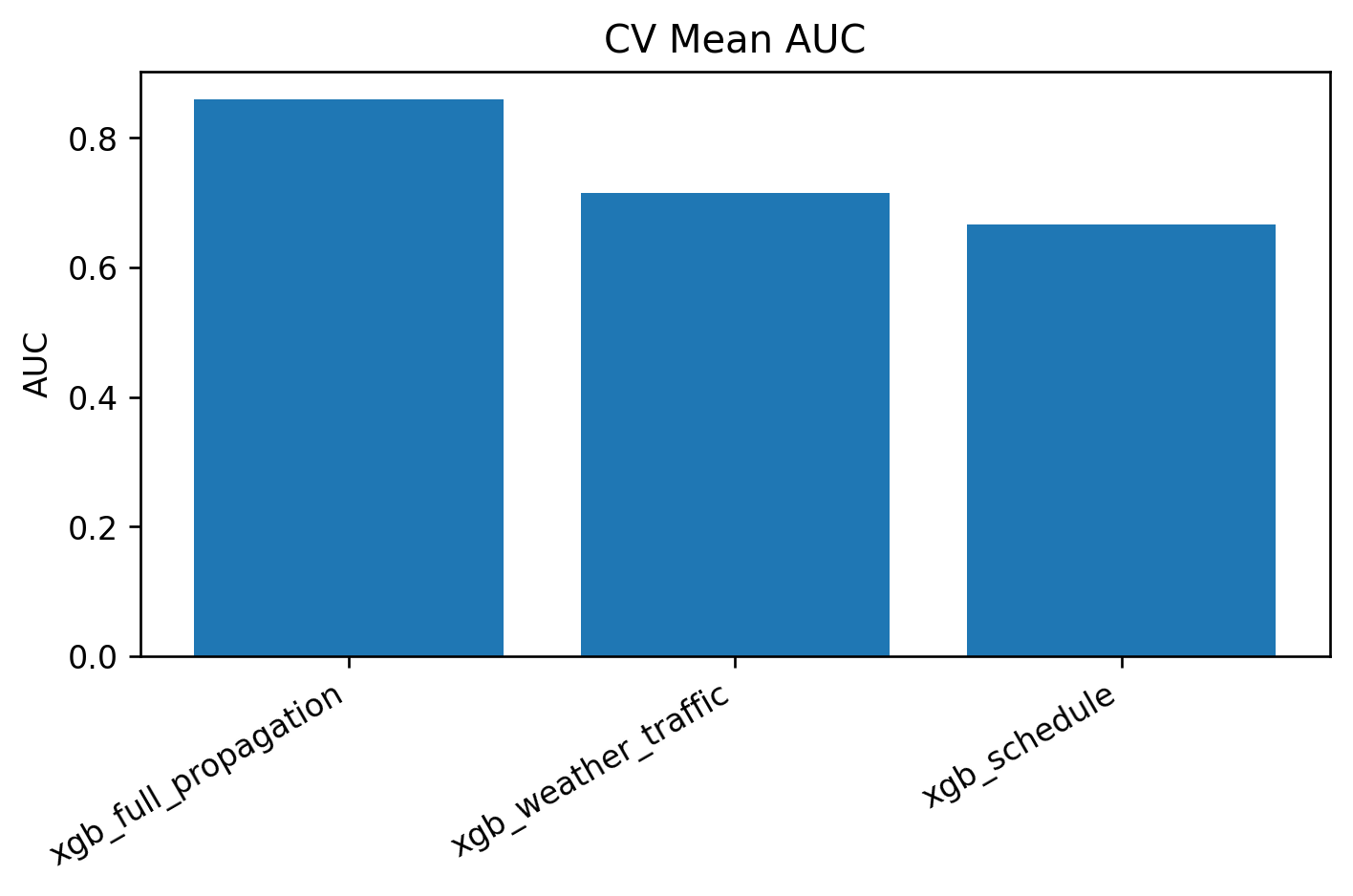
Classification CV Mean Results
                           auc        f1  precision    recall  accuracy
model                                                                  
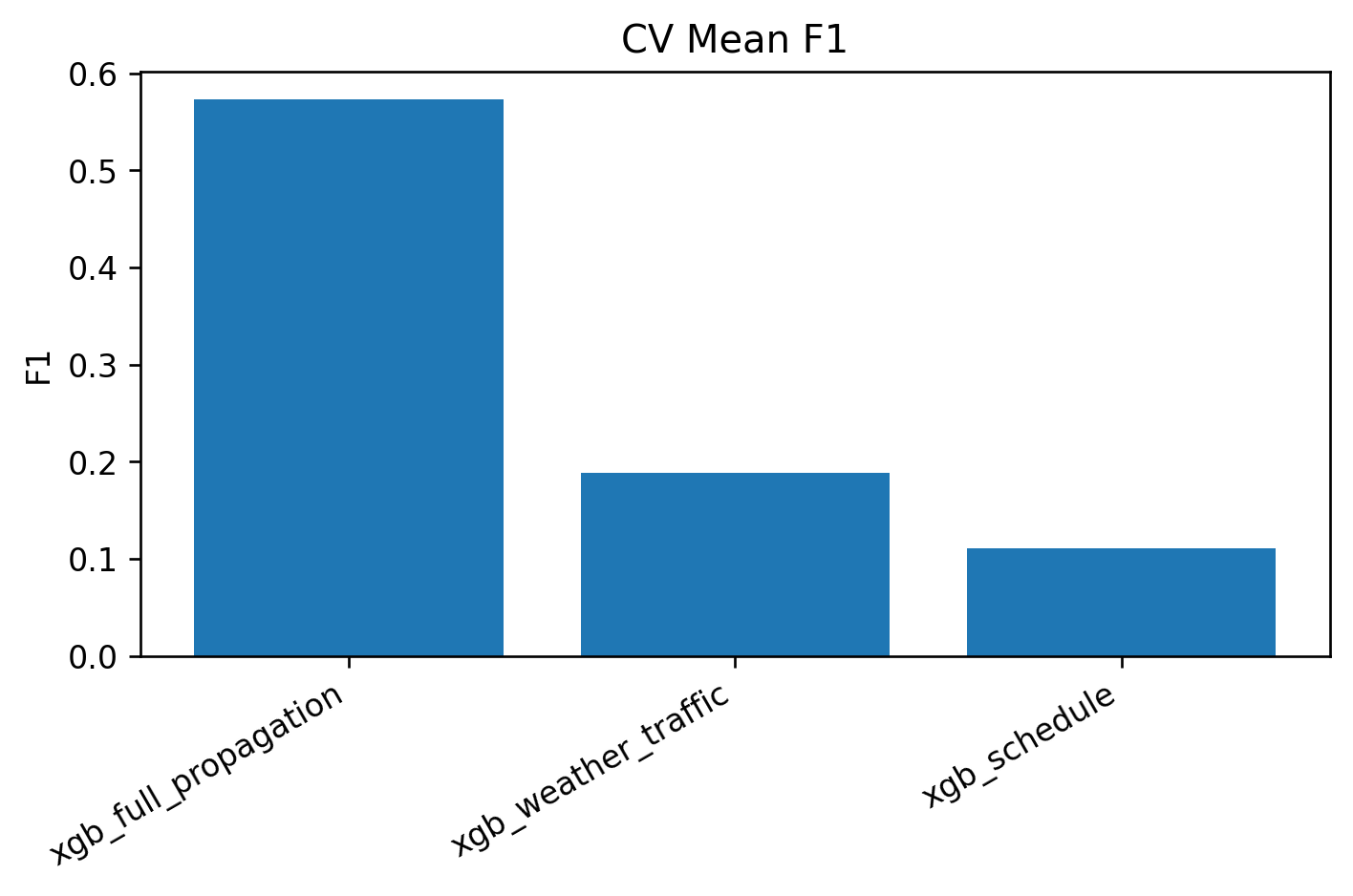
xgb_full_propagation  0.859863  0.573332   0.769503  0.458805  0.886574
xgb_weather_traffic   0.715396  0.188655   0.639621  0.112749  0.839107
xgb_schedule          0.666370  0.111148   0.664314  0.062374  0.836118

Regression CV Mean Results
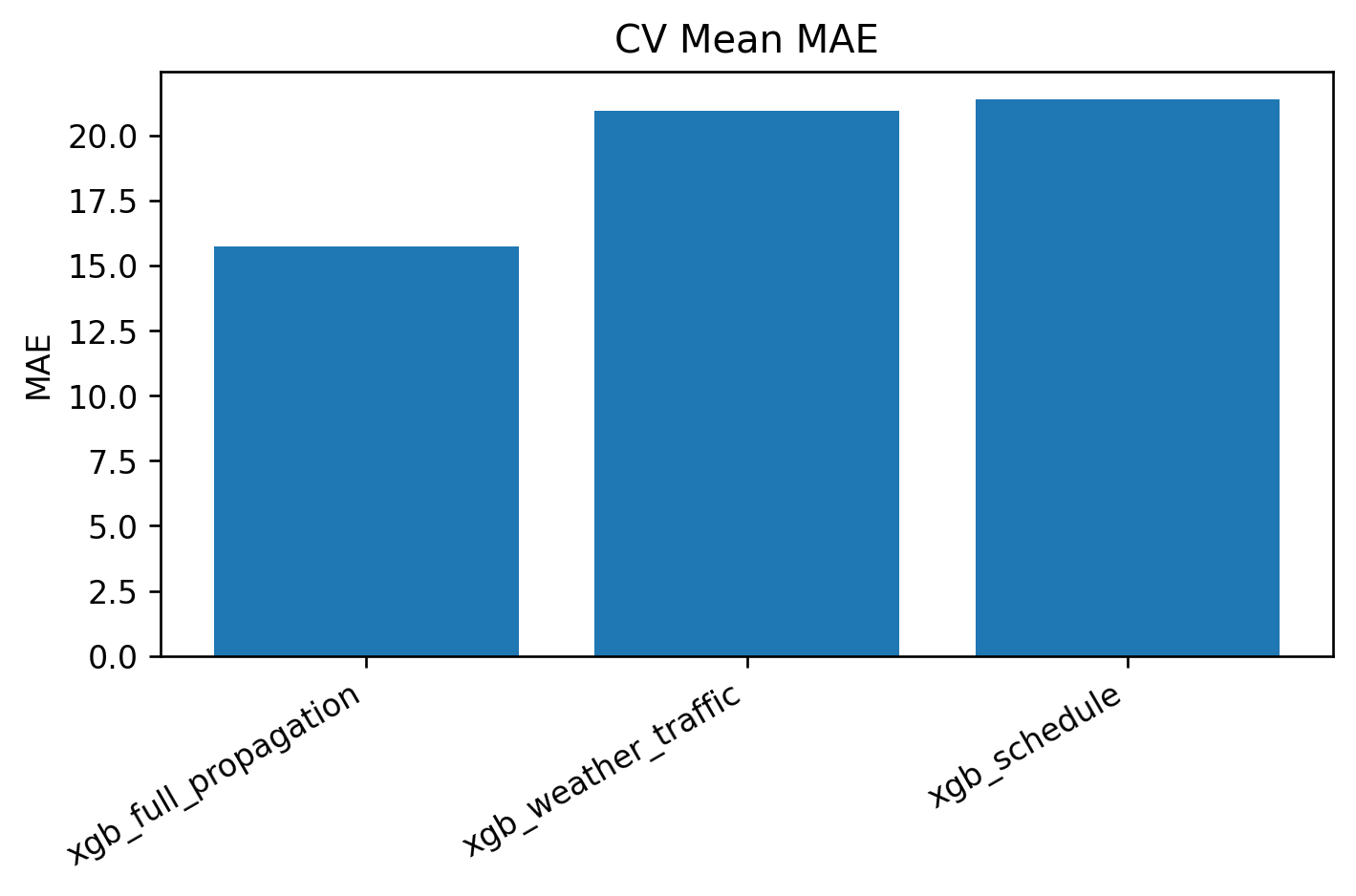
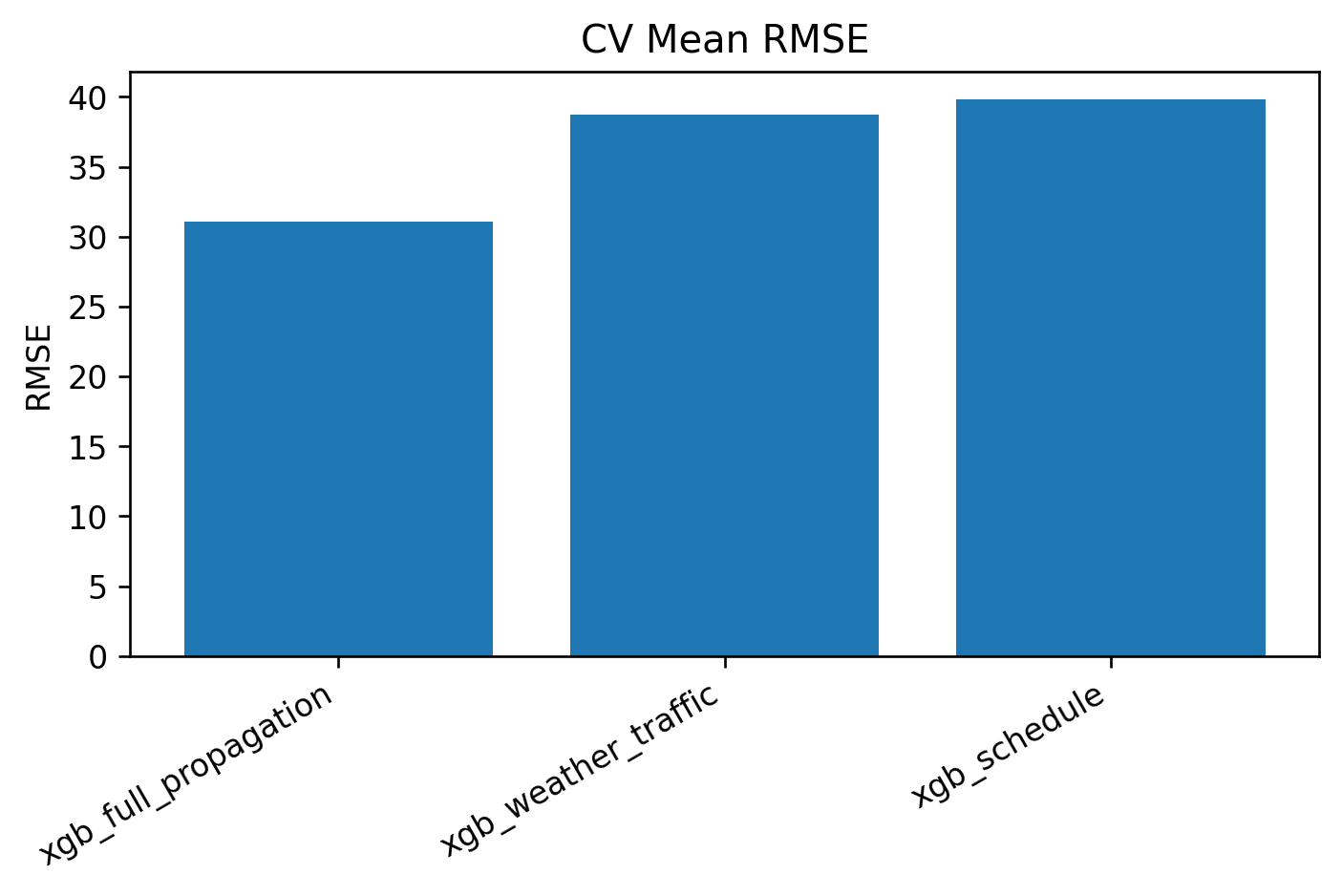
                            mae       rmse
model                                     
xgb_full_propagation  15.726139  31.105641
xgb_weather_traffic   20.935744  38.747776
xgb_schedule          21.394736  39.836722
[TIMER] Month-based CV block: 1057.09s

Final Training: Jan–Nov → December Holdout

Show code
def train_xgb_models(train_df, test_df, feature_sets):
    cls_results, reg_results, cls_preds, reg_preds, fitted_models = {}, {}, {}, {}, {}
    y_train_cls = train_df[TARGET_CLASS].to_pandas().astype(int)
    y_test_cls  = test_df[TARGET_CLASS].to_pandas().astype(int)
    y_train_reg = train_df[TARGET_REG].to_pandas().astype(float)
    y_test_reg  = test_df[TARGET_REG].to_pandas().astype(float)

    for model_name, cols in feature_sets.items():
        t_model = time.perf_counter()
        X_train = safe_fill_and_to_pandas(train_df, cols)
        X_test  = safe_fill_and_to_pandas(test_df,  cols)

        clf = XGBClassifier(n_estimators=300, max_depth=6, learning_rate=0.05,
                            subsample=0.8, colsample_bytree=0.8, eval_metric="logloss",
                            random_state=42, n_jobs=-1, device="cpu")
        clf.fit(X_train, y_train_cls)
        y_prob = clf.predict_proba(X_test)[:, 1]

        reg = XGBRegressor(n_estimators=300, max_depth=6, learning_rate=0.05,
                           subsample=0.8, colsample_bytree=0.8,
                           random_state=42, n_jobs=-1, device="cpu")
        reg.fit(X_train, y_train_reg)
        y_pred_reg = reg.predict(X_test)

        cls_results[model_name]   = classification_metrics(y_test_cls, y_prob)
        reg_results[model_name]   = regression_metrics(y_test_reg, y_pred_reg)
        cls_preds[model_name]     = y_prob
        reg_preds[model_name]     = y_pred_reg
        fitted_models[model_name] = {"classifier": clf, "regressor": reg, "features": cols}

        print(f"Done: {model_name}")
        timer_log(f"  Final XGB {model_name}", t_model)

    return cls_results, reg_results, cls_preds, reg_preds, fitted_models


t0 = time.perf_counter()
xgb_cls_results, xgb_reg_results, xgb_cls_preds, xgb_reg_preds, xgb_models = train_xgb_models(
    train_cv_df, holdout_df, xgb_feature_sets,
)
timer_log("Final XGBoost block", t0)
Done: xgb_schedule
[TIMER]   Final XGB xgb_schedule: 32.12s
Done: xgb_weather_traffic
[TIMER]   Final XGB xgb_weather_traffic: 40.30s
Done: xgb_full_propagation
[TIMER]   Final XGB xgb_full_propagation: 48.46s
[TIMER] Final XGBoost block: 120.89s

Final Holdout Results

Show code
cls_table = build_eval_table(xgb_cls_results).sort_values("auc", ascending=False)
reg_table = build_eval_table(xgb_reg_results).sort_values("mae", ascending=True)

print("Final December Holdout — Classification")
print(cls_table.to_string(index=False))
print("\nFinal December Holdout — Regression")
print(reg_table.to_string(index=False))
Final December Holdout — Classification
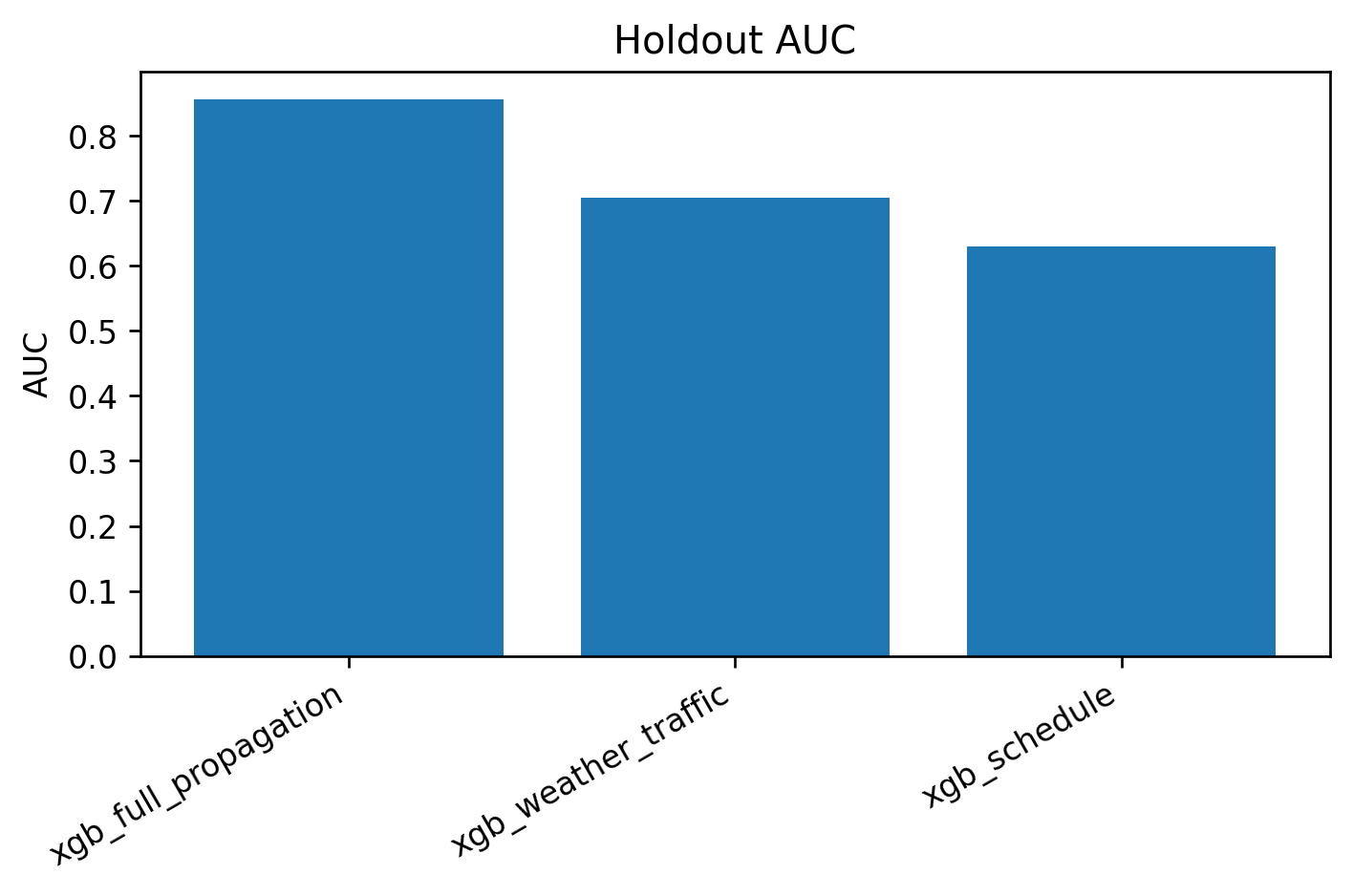
               model      auc       f1  precision   recall  accuracy
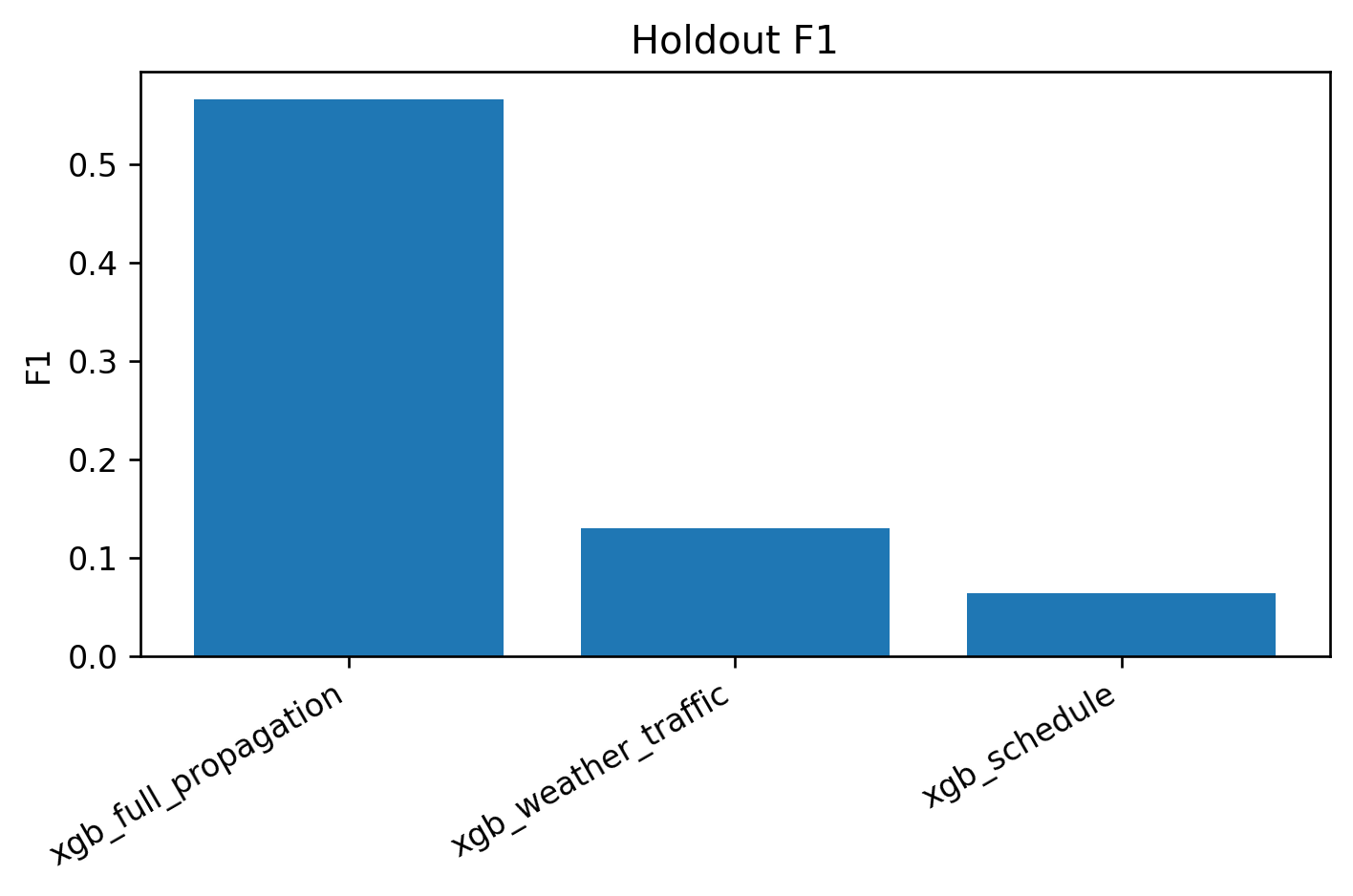
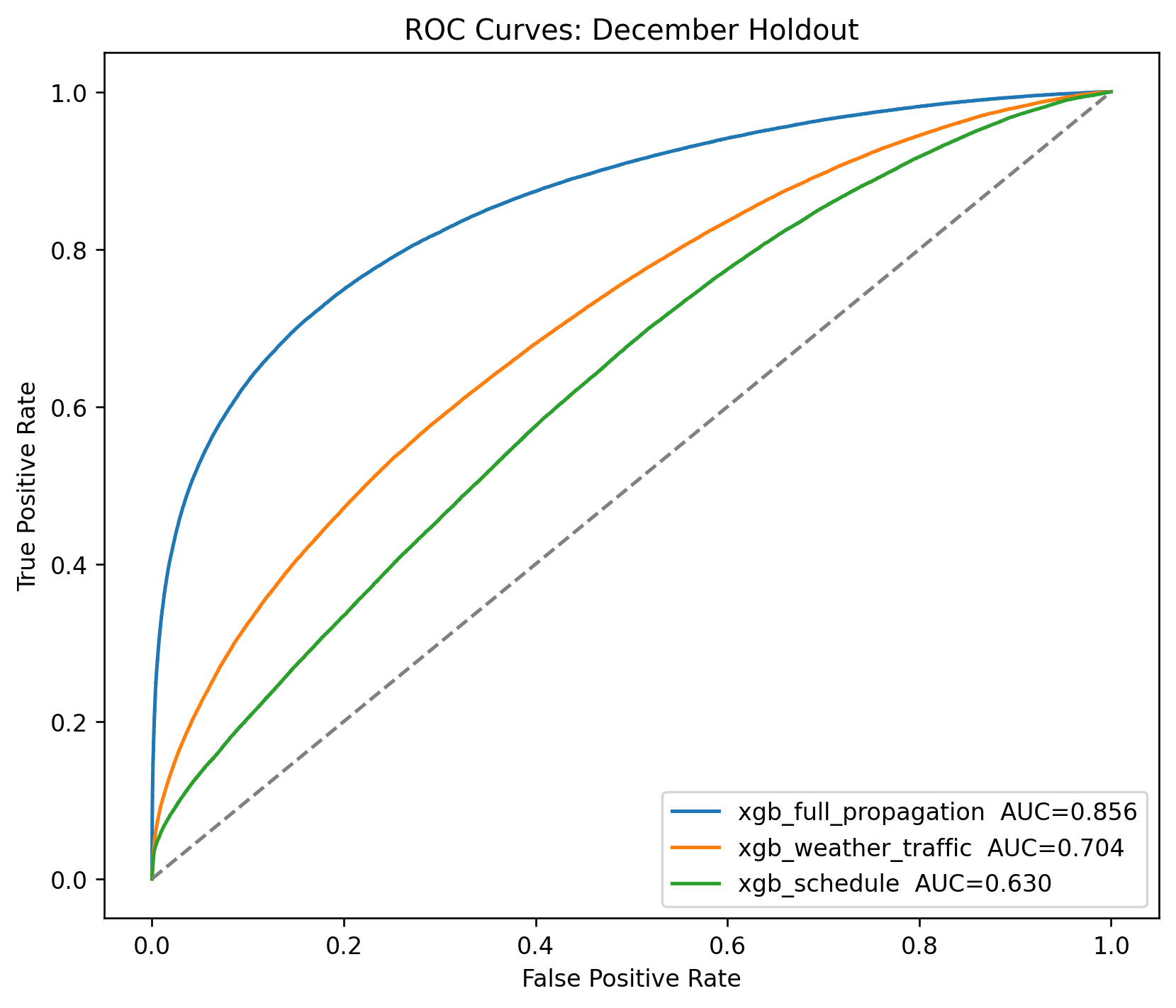
xgb_full_propagation 0.856345 0.566183   0.821926 0.431822  0.866752
 xgb_weather_traffic 0.704430 0.129951   0.765832 0.070999  0.808563
        xgb_schedule 0.630371 0.063940   0.799830 0.033301  0.803665

Final December Holdout — Regression
               model       mae      rmse
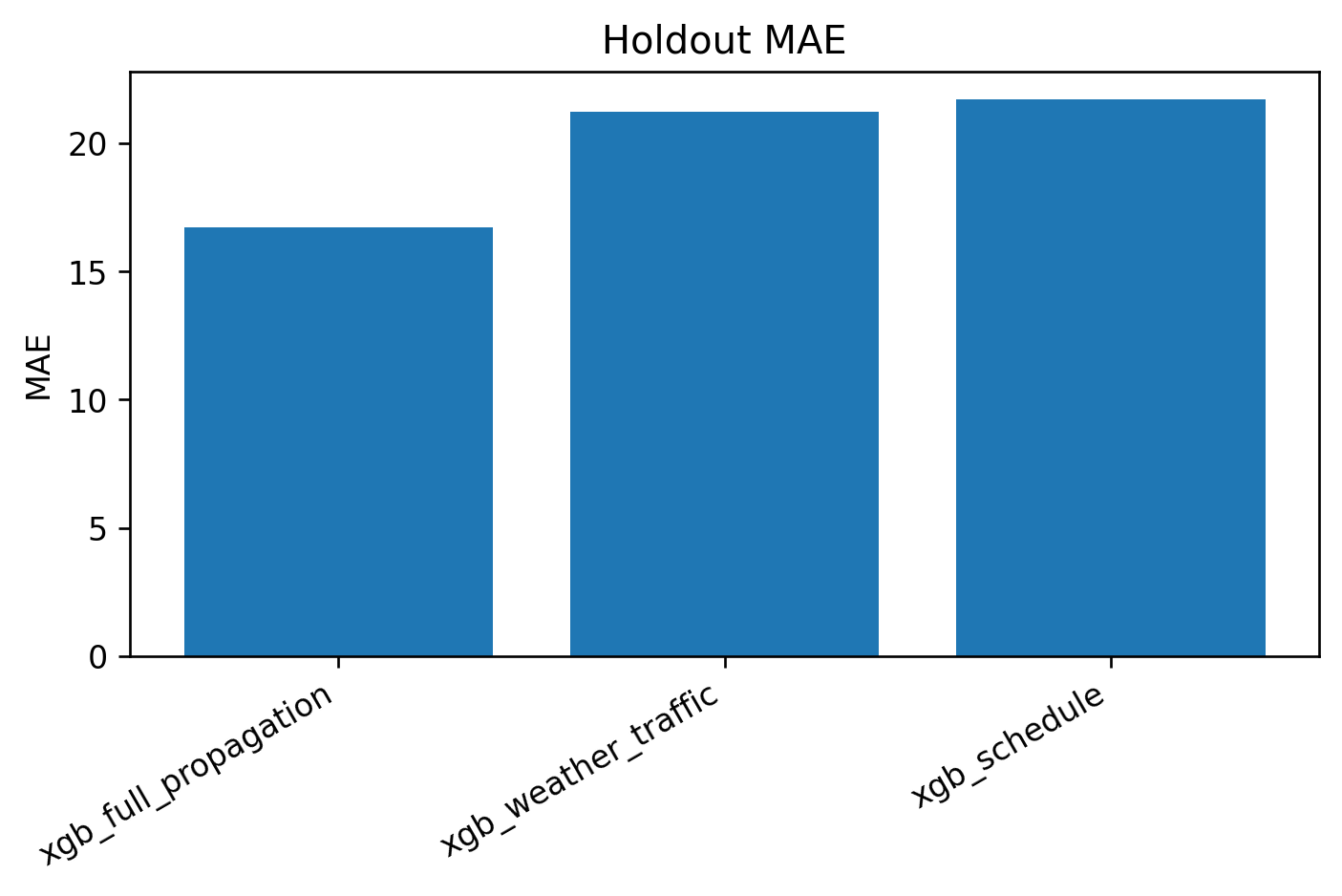
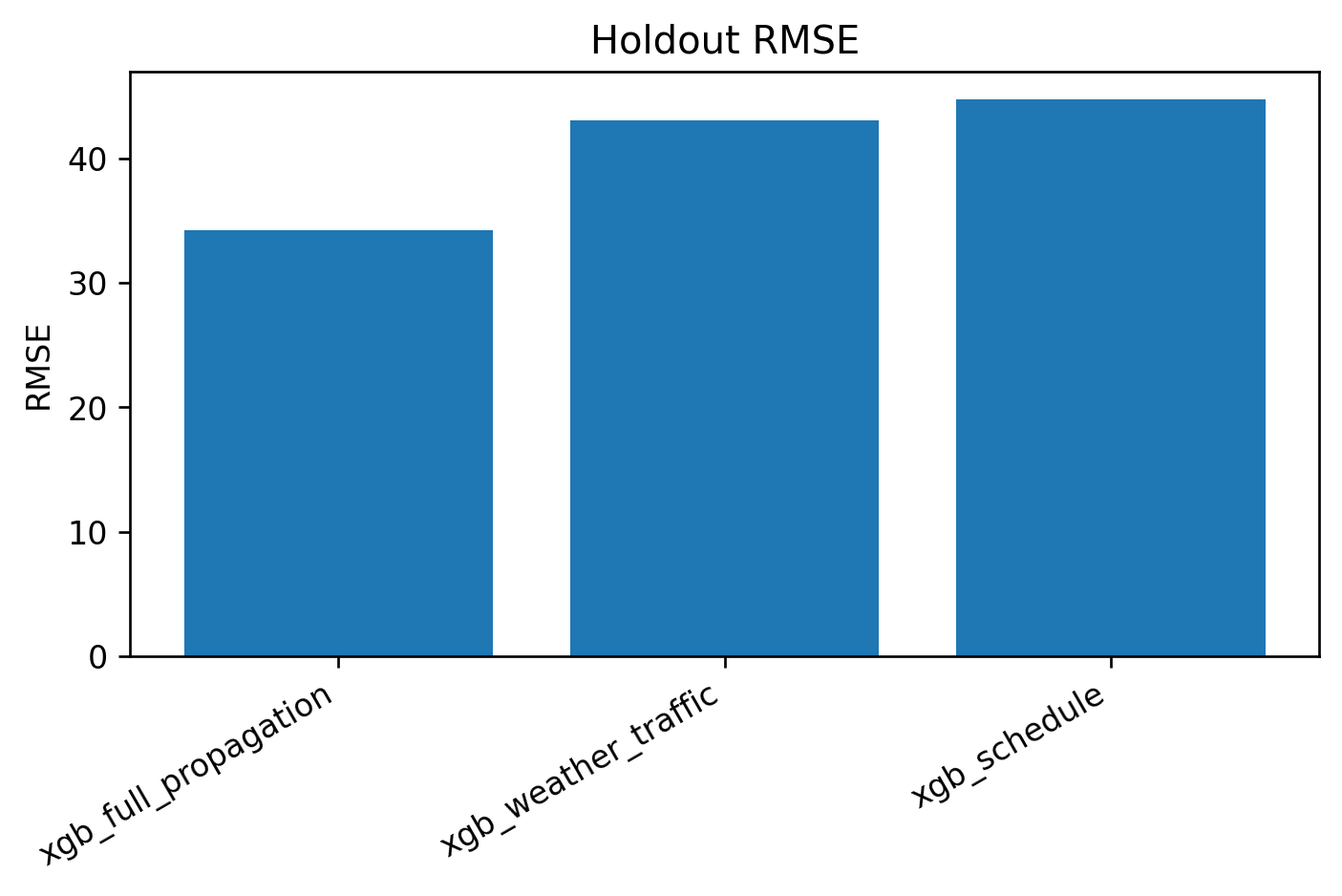
xgb_full_propagation 16.715222 34.244726
 xgb_weather_traffic 21.219616 43.069902
        xgb_schedule 21.721280 44.773405

Visualizations

CV Summary

Show code
def plot_metric_bars(df, metric, title, sort_ascending=False):
    plot_df = df.sort_values(metric, ascending=sort_ascending).copy()
    fig, ax = plt.subplots(figsize=(6, 4))
    ax.bar(plot_df["model"], plot_df[metric])
    ax.set_xticklabels(plot_df["model"], rotation=30, ha="right")
    ax.set_title(title); ax.set_ylabel(metric.upper())
    fig.tight_layout(); plt.show()

plot_metric_bars(cls_cv_mean_table.reset_index(), "auc",  "CV Mean AUC",  False)
plot_metric_bars(cls_cv_mean_table.reset_index(), "f1",   "CV Mean F1",   False)
plot_metric_bars(reg_cv_mean_table.reset_index(), "mae",  "CV Mean MAE",  True)
plot_metric_bars(reg_cv_mean_table.reset_index(), "rmse", "CV Mean RMSE", True)
(a) Mean AUC (higher is better)
(b) Mean F1 (higher is better)
(c) Mean MAE — minutes (lower is better)
(d) Mean RMSE — minutes (lower is better)
Figure 1: Cross-validation mean metrics across the three feature sets

December Holdout

Show code
plot_metric_bars(cls_table, "auc",  "Holdout AUC",  False)
plot_metric_bars(cls_table, "f1",   "Holdout F1",   False)
plot_metric_bars(reg_table, "mae",  "Holdout MAE",  True)
plot_metric_bars(reg_table, "rmse", "Holdout RMSE", True)
(a) AUC (higher is better)
(b) F1 (higher is better)
(c) MAE — minutes (lower is better)
(d) RMSE — minutes (lower is better)
Figure 2: December holdout metrics across the three feature sets

ROC Curves

Show code
y_test_cls = holdout_df[TARGET_CLASS].to_pandas().astype(int)
fig, ax = plt.subplots(figsize=(7, 6))
for model_name in cls_table["model"].tolist():
    y_prob = xgb_cls_preds[model_name]
    fpr, tpr, _ = roc_curve(y_test_cls, y_prob)
    ax.plot(fpr, tpr, label=f"{model_name}  AUC={roc_auc_score(y_test_cls, y_prob):.3f}")
ax.plot([0, 1], [0, 1], linestyle="--", color="grey")
ax.set_xlabel("False Positive Rate"); ax.set_ylabel("True Positive Rate")
ax.set_title("ROC Curves: December Holdout"); ax.legend()
fig.tight_layout(); plt.show()
Figure 3: ROC curves for all classification models on the December holdout

Actual vs Predicted

Show code
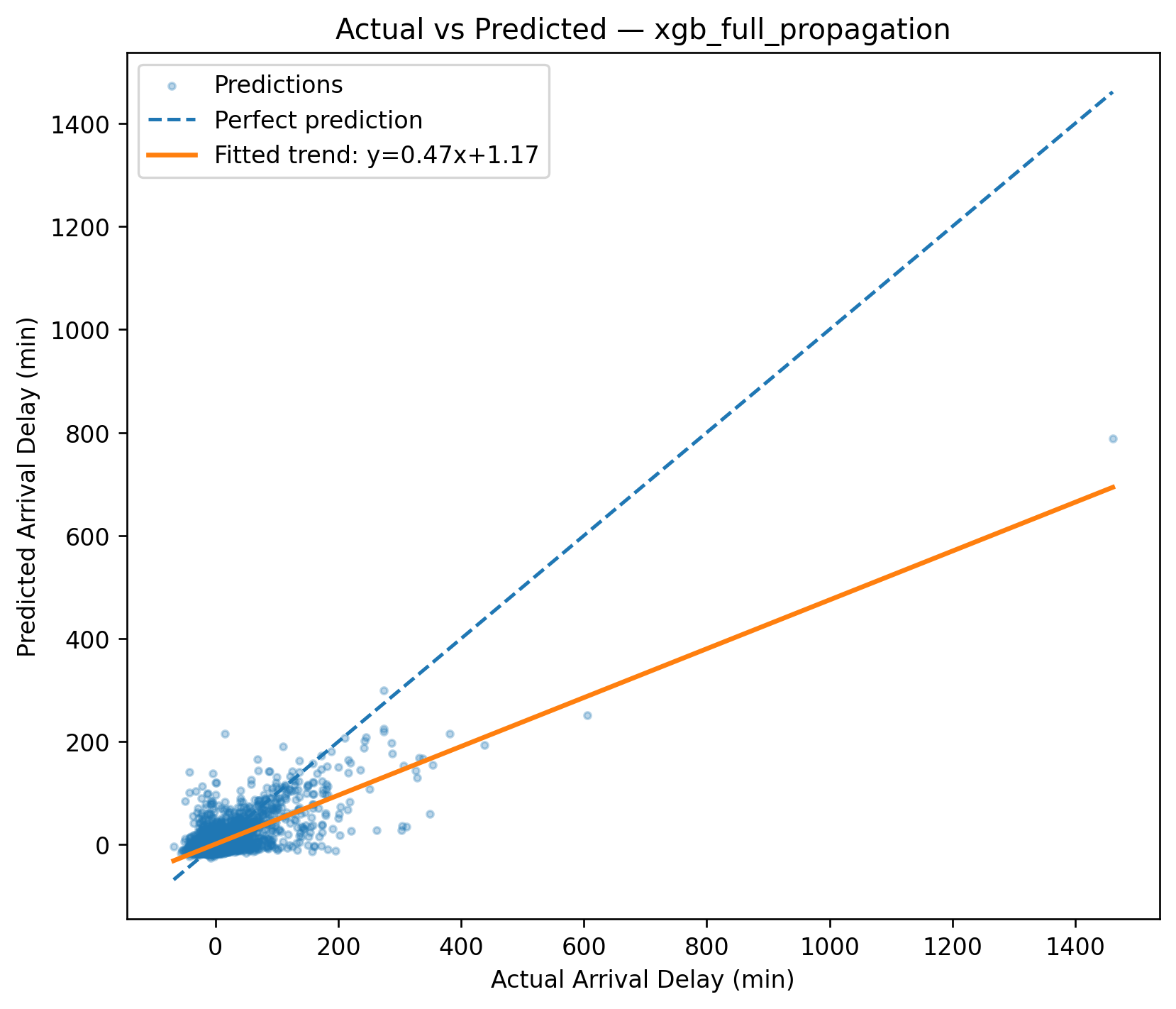
best_reg_model = reg_table.iloc[0]["model"]
y_test_reg     = holdout_df[TARGET_REG].to_pandas().astype(float)
best_pred_reg  = xgb_reg_preds[best_reg_model]
idx = np.random.RandomState(42).choice(len(y_test_reg), size=min(5000, len(y_test_reg)), replace=False)
actual_sample = y_test_reg.iloc[idx].to_numpy()
pred_sample   = np.array(best_pred_reg)[idx]
min_val = min(actual_sample.min(), pred_sample.min())
max_val = max(actual_sample.max(), pred_sample.max())
slope, intercept = np.polyfit(actual_sample, pred_sample, 1)
trend_x = np.linspace(min_val, max_val, 100)
fig, ax = plt.subplots(figsize=(7, 6))
ax.scatter(actual_sample, pred_sample, alpha=0.3, s=8, label="Predictions")
ax.plot([min_val, max_val], [min_val, max_val], linestyle="--", label="Perfect prediction")
ax.plot(trend_x, slope*trend_x + intercept, linewidth=2,
        label=f"Fitted trend: y={slope:.2f}x+{intercept:.2f}")
ax.set_xlabel("Actual Arrival Delay (min)"); ax.set_ylabel("Predicted Arrival Delay (min)")
ax.set_title(f"Actual vs Predicted — {best_reg_model}"); ax.legend()
fig.tight_layout(); plt.show()
Figure 4: Actual vs predicted arrival delay on the December holdout (5 000-flight sample)

Feature Importance

Show code
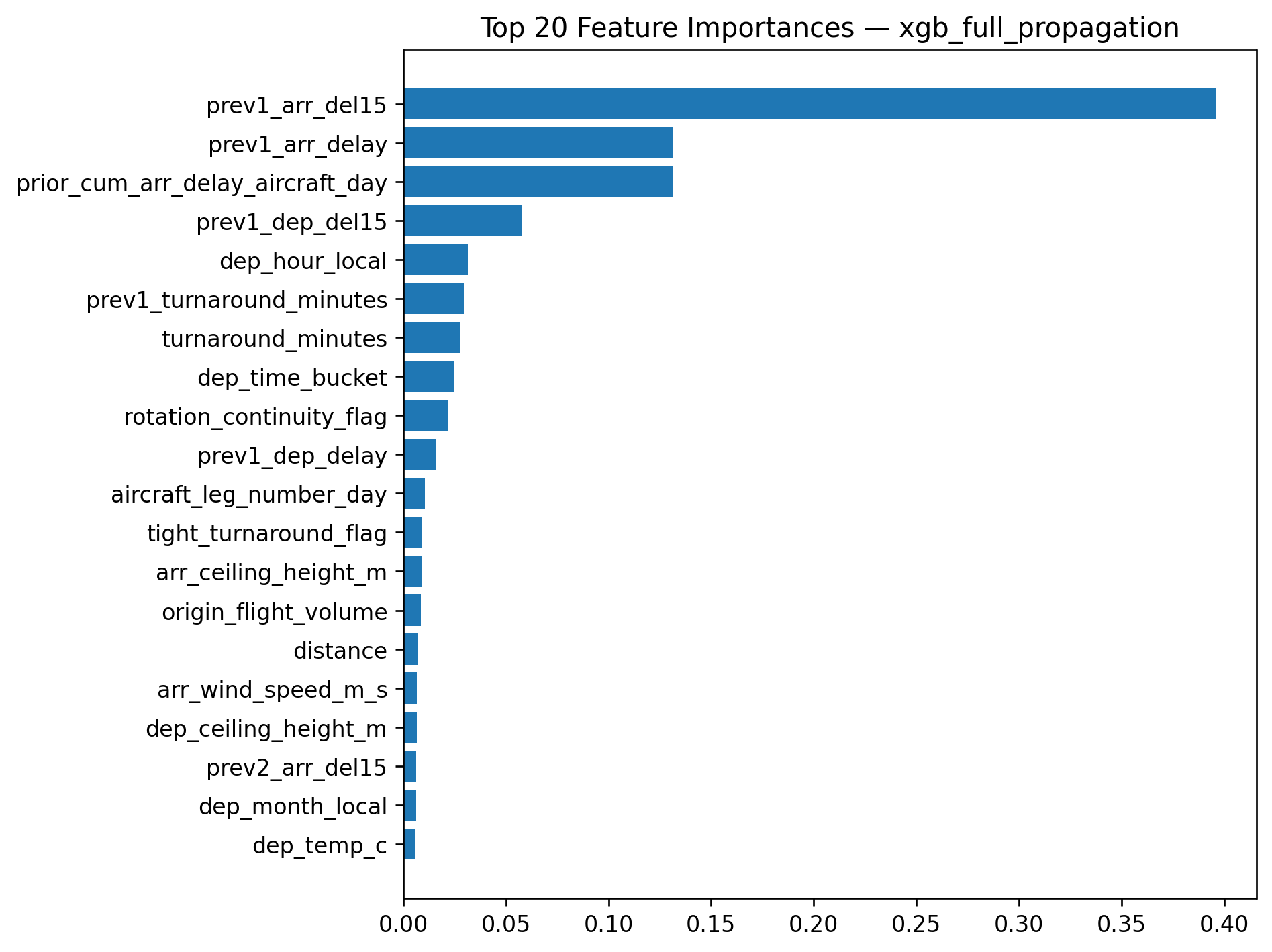
best_name     = cls_table.iloc[0]["model"]
best_xgb      = xgb_models[best_name]["classifier"]
best_features = xgb_models[best_name]["features"]
importance_df = (
    pd.DataFrame({"feature": best_features, "importance": best_xgb.feature_importances_})
    .sort_values("importance", ascending=False).head(20)
)
fig, ax = plt.subplots(figsize=(8, 6))
ax.barh(importance_df["feature"][::-1], importance_df["importance"][::-1])
ax.set_title(f"Top 20 Feature Importances — {best_name}")
fig.tight_layout(); plt.show()
Figure 5: Top 20 feature importances for the best XGBoost classifier

Pipeline Timing

Show code
timer_log("TOTAL PIPELINE TIME", GLOBAL_START)
[TIMER] TOTAL PIPELINE TIME: 1189.20s